

Goose Eye No. 6 (2026)
Prelude
Waponahkik, Undivided
Brett Ciccotelli, Stephen Engle, and Bryan Wentzell
We in the land conservation community love our maps—maybe even as much as we love the outdoors itself. Modern mapping software lets us layer hundreds of different data sets from bedrock to soil, land use, forest carbon, ownership, town lines, tree cover, conserved lands, trails, and now cellar holes and old forest roads. We anticipate some greater understanding of our world from adding more layers to the map. Maybe some yet unknown combination of layers or new data will point to the next most valuable property to protect. But how does our understanding shift if we actively remove layers from the map?
To be clear, maps have helped society make important land use and policy decisions, highlighting critical resources, showing disease patterns, or revealing injustices. Maps have also aided in the taking and exploitation of land and resources. A good map can simply capture our imagination, connect us to place, and more importantly depict the lands and waters that are the basis for all life. But many things that are often shown on maps—political boundaries, highways, dams, railroads, and cities—can also be barriers between us and the natural world.
This map strips away what is commonly on many maps and shows the landscape and waters as they are—or maybe as they want to or should be— unbroken by imposed political boundaries. We see more clearly the rivers, streams, lakes, and ponds and how they are connected, and how they have nearly always been.
This is a map of Waponahkik—Wabanaki Territory. Hundreds of generations of Wabanaki People have been in relationship with these lands and waters as depicted on this map. These lands and waters are the basis for Wabanaki culture and lifeways today.
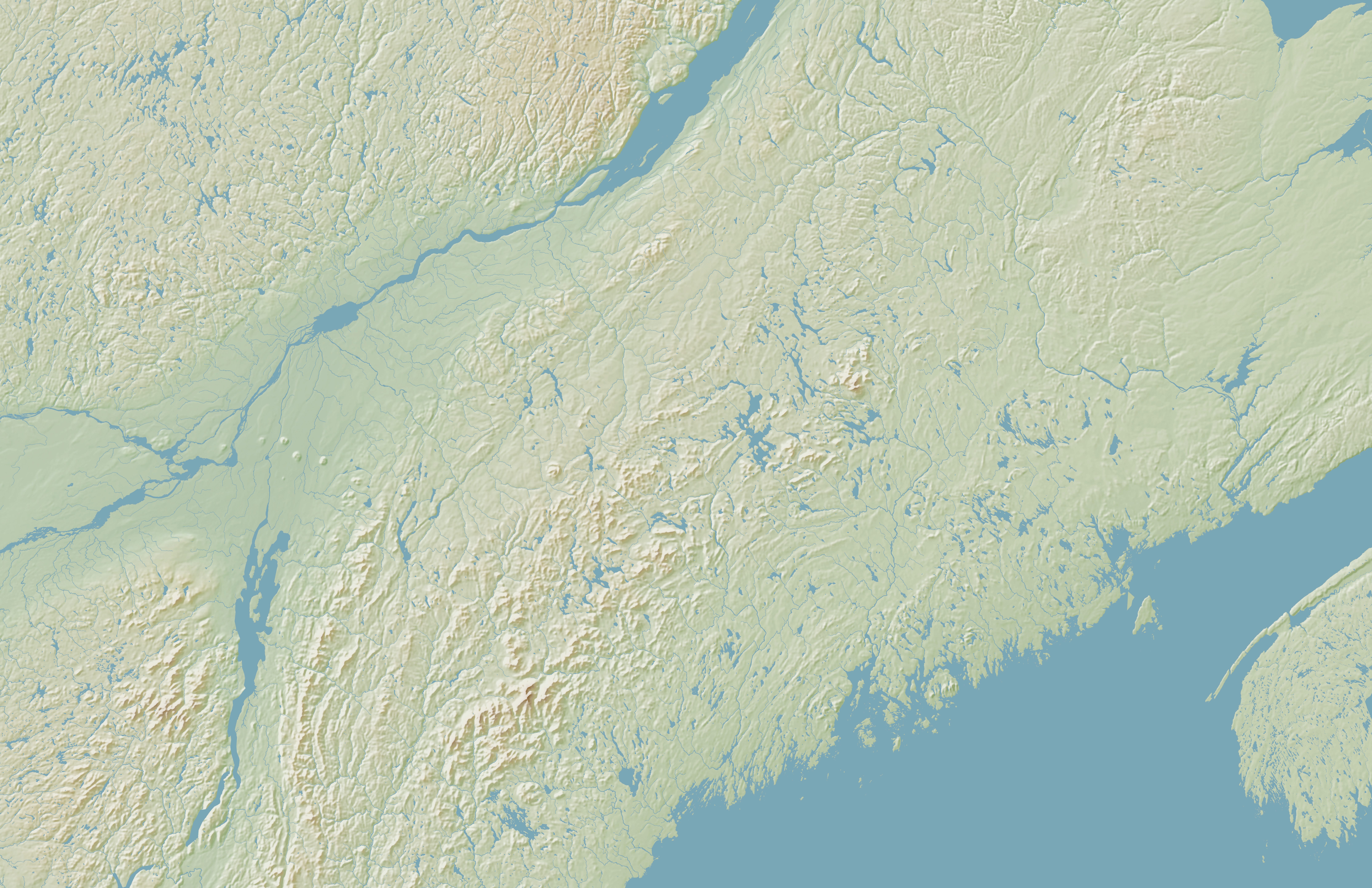
We often view the landscape literally from the perspective of roads, towns, and political borders. How does our perception of this landscape change without these features?
As we consider this map let us ask ourselves:
What new insights about place do we gain when more familiar administrative boundaries and modern transportation corridors are removed?
Do we learn more, not by adding more layers, but by stripping away those data sets to then contemplate the landscape that remains?
If all maps draw us in, does this representation of the landscape pull us in further and offer greater understanding....to appreciate the barriers that we’ve erected for creatures, to understand Wabanaki Territory and impacts of colonization, to contemplate our own positionality in a natural world that is not cut up by surveyors’ straight lines, to read the features that were carved into the landscape by ice sheets cutting, grinding, and shaping the geology and geomorphology of the region?
Do we feel unmoored because familiar, common landmarks are erased, challenging us to ask ourselves how well we actually know this region’s mountain ranges, shorelines, and waterways? What is my home (if there are no town, state, or federal boundaries showing?)
How can we turn our feelings of confusion and disorientation into deeper knowledge, appreciation, connection, relationship, and repair?