

Goose Eye No. 1 (2021)
The Battle Revisited
Details of “Lovewell’s Fight” of 1725 Found to Be in Error
16 Years of Research by Fannie Hardy Eckstorm Results in a Rewrite of History
David Crouse
It’s an old story that’s been told and retold innumerable times—a saga that’s been written and rewritten by countless historians and journalists. Yet, for about 200 years, no one seriously delved into the details of the traditional account of the incident. The story to which I refer is the 1725 Battle of Lovewells Pond (then called Saco Pond) in Fryeburg (then known as Pigwacket). Historically this battle was known as “Lovewell’s Fight,” for it’s the story of Captain John Lovewell and his men, who engaged the Abenaki in a one-day skirmish which not only had a significant impact on the history of northern New England, but also changed the way in which subsequent battles with Native Americans were fought.
Most accounts of Lovewell’s Fight are based on (or are faithful reproductions of) the original account written a few days after the incident by Rev. Thomas Symmes of Bradford, Massachusetts, and delivered as a sermon on May 16, 1725.1 It’s impossible to determine just how many times Symmes’ account (and variations thereof) have been published in the many years since the battle, but it could possibly run into the hundreds, for as Frederic Kidder wrote in 1865, “No event, from that time to the Revolution, had taken so strong a hold of the feelings of the people, or had so constantly been the theme of the fireside and of the soldier.”2 Many of these published accounts were written by fairly eminent historians such as Jeremy Belknap (The History of New Hampshire, 1813), Nathaniel Bouton (1861), and Francis Parkman (A Half-Century of Conflict, 1899), to mention just a few. A fairly recent account was published in a North Conway, N.H., weekly, The Mountain Ear, on November 22, 1995, written by Karen Cummings, who drew heavily on Frederic Kidder’s 1865 book on the battle.
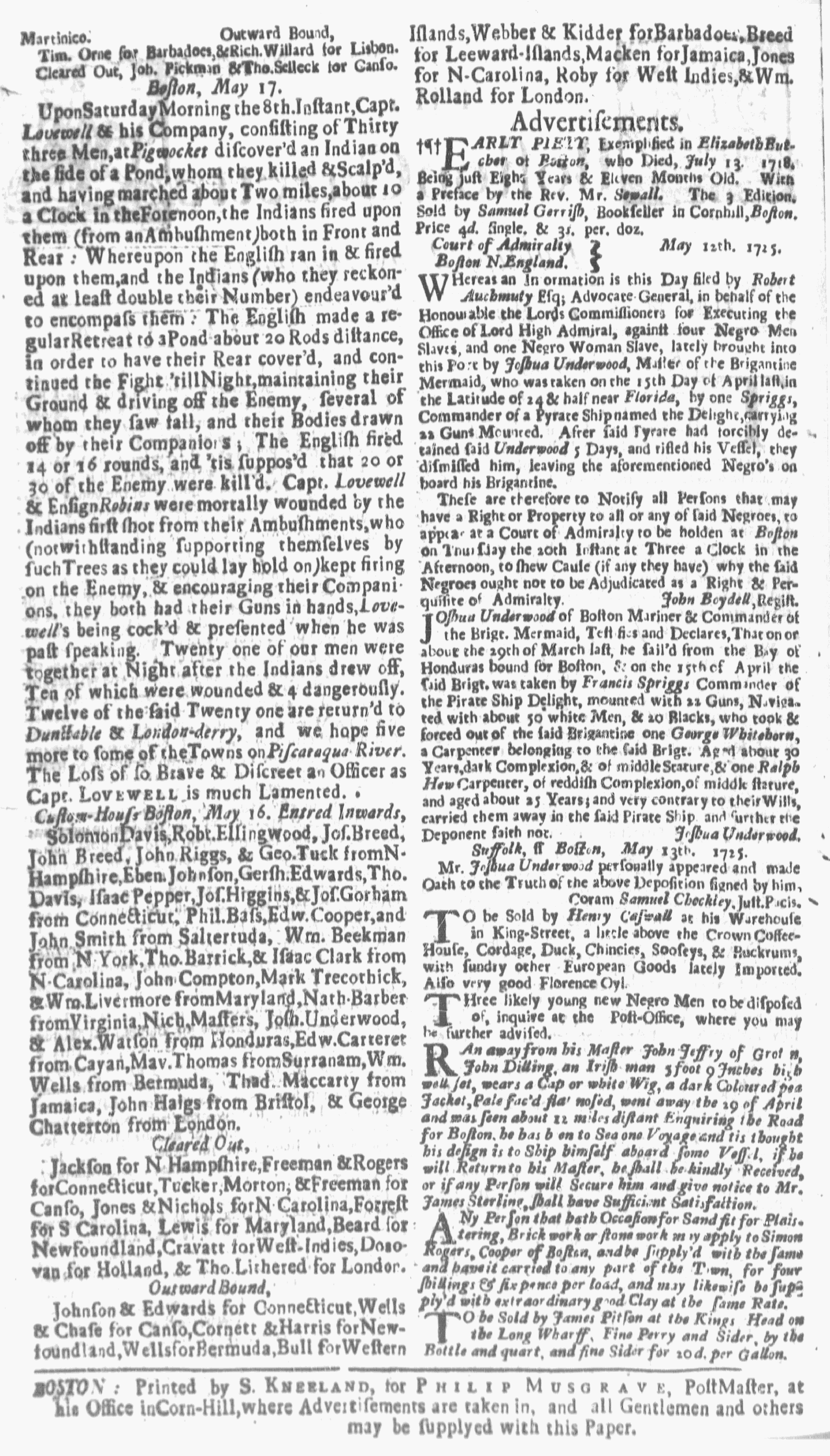
As mentioned previously, most of those who have written about the battle have generally followed the 1725 account by the Reverend Symmes without seriously questioning its accuracy, which is quite understandable since Symmes undoubtedly had the benefit of first-hand information from the survivors of the battle. However, subsequent authors, writing soon after the event, added a few more details to the saga which heightened the drama of the event, and in 1865 Frederic Kidder wrote, “It will be difficult for any succeeding gleaner in this field to add anything of value to what is now, much of it for the first time, published.”3 But little did Kidder know that one month after he wrote this a child was born in Brewer, Maine, who would grow up to add considerably to the accepted version of Lovewell’s Fight.
That child was Fannie Hardy, who was born on June 18, 1865, educated at Abbot Academy in Andover, Mass., and graduated from Smith College in 1888. In 1893 she married Rev. Jacob A. Eckstorm, and eventually became a nationally known author. Her favorite subjects were life in the Maine woods; birds; New England Indian tribes and customs, on which she became an authority; colonial history; folk songs; and game laws. She was the author of several books and innumerable magazine articles on these subjects.4 Mrs. Eckstorm also gave lectures, and about 1915, while preparing a talk on Lovewell’s Fight, she determined that the recorded facts didn’t fit together to her satisfaction. So she launched into a detailed study of the subject and spent the next sixteen years attempting to set the facts a little bit straighter. In the late 1930s a few magazine articles were published which summarize the major findings of her study, but the complete results of her research have apparently never been published, for in the vault at the Bangor Public Library, there is a typewritten document by Mrs. Eckstorm, dated March 1931, and labeled “Manuscript of unpublished book, acquired by Bangor Public Library, March 18, 1954.” The title of this work is “The Old Fight at Pigwacket, 1725: A Critical Examination of the Rev. Thomas Symmes’s Historical Memoirs and of the Data of Capt. John Lovewell’s Great Fight with the Indians.” A microfilm copy of this manuscript is also available at the Bangor Public Library, and at the Raymond H. Fogler Library at the University of Maine in Orono. Some of Mrs. Eckstorm’s research is contained in articles published in The New England Quarterly in 1936 and 1939.5
The Eckstorm manuscript contains nearly three hundred pages of text which explain in great detail the basis for the conclusions she made. In a summary (included below), she presents a simplified version of Lovewell’s Fight, which gives the reader a general overview of the incident. It is, however, devoid of the personalities and details that make the story most interesting, so a more complete account by Francis Parkman will be found on pages 48-53 of this issue. Except for a few details, Parkman’s version is fairly consistent with Ekstorm’s findings.
What Fannie Hardy Eckstorm Found That Was Not Consistent with More Traditional Accounts of the Battle
The most important discovery that Mrs. Ekstorm made was that the battle actually took place on Sunday, May 9, 1725; not on Saturday, May 8, as Rev. Symmes’ account claims.6 In her opinion the motive for the change of date is clear: It was to cover up the fact that Chaplain Jonathan Frye was involved in the taking of a Native scalp on the Sabbath day, something that was definitely prohibited by the Church at that time. (Not that his scalp hunting was thought in those days to be wrong, but that it was done on the Sabbath.) The Reverend Symmes had a fairly close relationship with the Frye family, and Jonathan Frye (twenty years old and a 1723 graduate of Harvard) was probably even a pupil of Symmes. Jonathan’s father, Captain James Frye (a grand-uncle to General Joseph Frye, the founder of Fryeburg, Maine), was a prominent citizen of Andover, Massachusetts, and apparently had high hopes for his only surviving son, Jonathan; but those hopes were very much diminished by the fact that young Jonathan had fallen in love with Susanna Rogers, the fourteen-year-old daughter of the minister at Boxford, Massachusetts. Even though he was a minister, the Reverend Rogers was not (in the opinion of the Fryes) of the social standing of the Frye family, so Captain James opposed Jonathan’s marriage plans and apparently threatened disinheritance. Jonathan, however, was not to be put off by his family’s position on the subject, so he decided to go it alone and raise enough money to marry Susanna by joining Lovewell’s expedition in search of Native scalps which were worth a hundred pound apiece. Jonathan was successful in his quest, for he was the one who went forward to take the first scalp at Pigwacket, but he had to have it done for him, because of his ignorance of the method of scalping. Unfortunately, however, he was later wounded in the battle and died. Soon after his death Jonathan’s lover, Susanna Rogers, penned a ballad in memory of him, but the poem, even as late as 1865, was never attributed to her.
Several accounts of the Battle attribute the death of Chief Paugus to Ensign Seth Wyman, but research seems to indicate that it was John Chamberlain who killed him, and that Wyman killed the medicine man, who was stirring up the Abenaki for a last fierce attack which could have resulted in the complete annihilation of Lovewell’s remaining men.
In some of the accounts that attribute the killing of Chief Paugus to John Chamberlain, it is said that Chamberlain and Paugus fought a duel, each having gone to the shore of the pond to wash his fouled and empty gun. But Mrs. Eckstorm seems to prove that it never happened—that it is a myth of unknown origin.
And who was Chief Paugus? Mrs. Eckstorm’s research concluded, in her own words, that:
The facts are these. There was a Scaticook Indian named Paucanaulemet [a name which was corrupted by the English to Paugus], living near Albany, New York, a ward of the Mohawks. While hunting with his family near Concord, New Hampshire, he was taken captive and carried to Boston and there kept in prison for more than a year. Released at the request of the Mohawks, he went home to Scaticook and the next year slipped away and joined the St. Francis Indians of Canada. In September, 1724, Paugus was with a war party of French Mohawks who attacked Old Dunstable [the home of Captain John Lovewell] and killed a number of people. The next spring he raided the Maine coast and, while returning to Pigwacket, engaged Captain John Lovewell’s troop at Saco Pond. There he was killed, May 9, 1725, and there he lies buried. The rest is folklore.
And why Pigwacket, rather than the more common spelling, Pequwaket? Eckstorm’s fairly exhaustive research into the history of the various spellings of this word found the most likely correct spelling to be Pigwacket, which means “at-the-punched-up-through-hill”, which in her opinion accurately describes Jockey Cap hill. According to Mrs. Ekstorm, Pequawket is an entirely different word meaning “hole-in-the-ground.” Eckstorm writes,
[Jockey Cap] is the landmark of the whole region: whether coming up Lovewell’s Pond and seeking the [Indian] village, or coming down the Saco from the White Mountains and seeking the carry to the pond, all the Indian had to do was steer for that unmistakable mountain, equally visible from either direction, and he could not fail to find the town and the carry.
In coming to her conclusion she explains that:
Every Indian place-name has a meaning, or did have one before it became hopelessly corrupted. Ordinarily the meaning was descriptive of some physical characteristic of the place, or it indicated some animal or plant which might be looked for there. The Indian’s place-names were his map of a region, his means of determining where he was or of telling another where to go. Thus the same name was not bestowed indiscriminately upon a mountain, a pond and a river, as the English confer them; it applied to only one of these features, and something in the name indicated whether it was a land-name or a water-name…. Pigwacket was a mountain name, because -ocket or -wocket means “at the mountain”. It does not matter that early maps and papers apply the name to the whole region around Fryeburg for many miles, to several hills or mountains near, to a small river to the west, to Mount Kearsarge and to other hills—this was all English usage, an extension of the original word which cannot affect its meaning except by obscuring it.
One other minor detail that Mrs. Ecktorm corrected in the traditional account is that Lovewell’s men saw the first lone Native on Moose Rock, on the western side of the pond, rather than on Indian Point, which is on the east side.


Summary of Capt. John Lovewell’s 1725 Expedition to Pigwacket
By Fannie Hardy Eckstorm7
On April 15, 1725, Capt. John Lovewell of Dunstable, Mass. [now Dunstable, NH], with a company of forty-seven men, including himself and a Mohawk Indian, who soon returned, left Nashua, N. H., on a punitive expedition against the Indians living at Pigwacket, now Fryeburg, Maine, on the upper Saco River.
They had six canoes and ample supplies for a month. Three men soon dropped out, leaving forty-four in the company. They went up the Merrimack River, crossed Lake Winnepesaukee to some point near the present Melvin Village, and from there carried over a low shoulder of Ossipee Mountain such supplies as they thought would be needed and halted on the westerly side of Lake Ossipee near the easterly boundary of New Hampshire. Here ten men were left to build a small stockade for a base, while Lovewell and thirty-three others, probably on May 6, headed north along the general course of the Little Pequawket River until they came to the Saco, in Conway, below its confluence with the Swift River. They followed down the right bank of the Saco to the Indian camps at Pigwacket, found them deserted (else they would have fought there), kept on into the Great Bend of the Saco, and striking the head of Fight Brook upon high land, followed it down to Saco, now Lovewell’s, Pond.
Saturday night they camped near the mouth of Fight Brook and on Sunday morning, May 9, while at religious service, they heard a gun and soon saw an Indian across the pond, presumably not far from the Moose Rock. Leaving their packs near their camp-ground, they traveled west to still-hunt the Indian hunter, whom they found and killed. But meanwhile a large war-party which had been raiding the Maine coast, returning home to Pigwacket village up the eastern side of Saco Pond, found the packs they had left and prepared to ambush the scouts on their return. There were not less than sixty Indians against thirty-four English, and it is probable that the Indians were fully double the number of the whites, with all the advantage of being on their ground and making a surprise attack.
The battle was probably joined not far from the present Battle Monument and was at first a hand-to-hand encounter, with very heavy losses on both sides. During this part of the engagement, one of the scouts, finding himself separated from the others and being very much frightened, ran away and made his way back to the stockade with the report that the troop was all killed. All the officers except one having either been killed or mortally wounded in the first onset, the command fell upon Ensign Seth Wyman, who saw that the only chance to save his company was to change the type of fighting. He therefore withdrew his men to a favorable place near the mouth of Fight Brook, where there was some rude protection, probably fallen trees, and here put up a stubborn defense. The Indians could neither drive nor draw them out of the place, and after fighting all day and finding themselves the losers in killed and wounded, they withdrew about sunset, leaving the English in possession of the field and of the dead of both parties.
Of the thirty-three English actually fighting, twelve died upon the field and were buried there later. One escaped in a canoe, when too much hurt to fight longer. The remaining twenty, some hours before midnight, left the battlefield together and eventually all but three of them got home, together with the man in the canoe, making eighteen actual survivors of the fight, excluding the deserter.
The Indians admitted having forty killed and others wounded. They lost their best war-chief and their medicine-man and, though a war party, just returning from a victorious raid along the coast and unhampered by the defense of women and children, they suffered the extreme humiliation of being beaten upon the outskirts of their own home village by a troop hardly half as large as their own. It was an overwhelming defeat. The Indians never again permanently occupied their favorite villages on the upper Saco, and most of them joined other tribes as refugees. The English, on the other hand, gained enormously in confidence and prestige and realized that they had found a method of fighting adapted to the conditions of savage warfare. From this time the woods scouts and riflemen became the right arm of the service in the struggle to win and hold territory. The Fight at Lovewell’s Pond was more than a trifling local victory by thirty-three scouts; it marked the beginning of a new era in the conquest of America.
The Town of Lovell, Maine, named for Captain John Lovewell
In 1727, two years after the Battle of Lovewell’s Pond, the Massachusetts General Court granted land to the white survivors of the battle. This grant was located about six miles south of what is now Concord, New Hampshire; but at that time Massachusetts, among others, claimed jurisdiction. The grant was settled in 1728 by 60 men, 46 of whom were either in the battle of Pigwacket or were heirs of men who were killed at Pigwacket. The settlement originally took the Native name of Suncook, but is now known as Pembroke. In 1740 the boundary between Massachusetts and New Hampshire was finally established by the King of England, causing doubt to be cast upon the validity of the Lovewell grant. Consequently, settlers petitioned for redress from Massachusetts, asking for another grant of land located at some place where their land titles could not be challenged. Their choice was a tract located in the District of Maine, on the east side of the Saco River, north of the Frye Grant. Their petition was granted on February 5, 1774, but only one of the men who fought with Lovewell ever saw the new land, and that was Sgt. Noah Johnson, the last survivor of the battle. This new settlement was named New Suncook, but was later, on November 15, 1800, incorporated as the Town of Lovell, in memory of Captain John Lovewell.8
Justin Winsor, “Authorities on the French and Indian Wars of New England and Acadia, 1688-1763,” in Narrative and Critical History of America, ed. Justin Winsor (Boston: Houghton, Mifflin, 1887), 5:431.
Frederic Kidder, The Expeditions of Capt. John Lovewell, and his Encounters with the Indians; Including a Particular Account of Pequauket Battle, with a History of that Tribe; and a reprint of Rev. Thomas Symmes's Sermon (Boston: Bartlett and Halliday, 1865), 7.
Kidder, The Expeditions of Capt. John Lovewell, 8.
The National Cyclopædia of American Biography (New York: James T. White, 1950), 36:199.
Fannie Hardy Eckstorm, “Pigwacket and Parsons Symmes,” The New England Quarterly 9, no. 3 (1936): 378-402; Eckstorm, "Who Was Paugus?" The New England Quarterly 12, no. 2 (1939): 203-26.
All references in this section are to Fannie Hardy Eckstorm, “The Old Fight at Pigwacket, 1725: A Critical Examination of the Rev. Thomas Symmes’s Historical Memoirs and of the Data of Capt. John Lovewell’s Great Fight with the Indians,” (unpublished manuscript, March 1931), Bangor Public Library, Bangor, Maine.
This section is excerpted from Eckstorm, “The Old Fight at Pigwacket,” 164-166.
Pauline W. Moore, Blueberries and Pusley Weed: The Story of Lovell, Maine (Kennebunk, Maine: Starr Press, Inc.; 1970), 5-7.