


Goose Eye No. 1 (2021)
Roaring Dan Seavey
The Western Maine Roots of a Legendary Great Lakes Pirate
William F. Chapman
It sounded like something out of a Robert Louis Stevenson story. A commandeered vessel. A stolen load of cargo. A chase on the high seas. The setting, however, was not the 17th century Caribbean. The year was 1908 and the sea was Lake Michigan. The man was Captain Daniel W. Seavey.
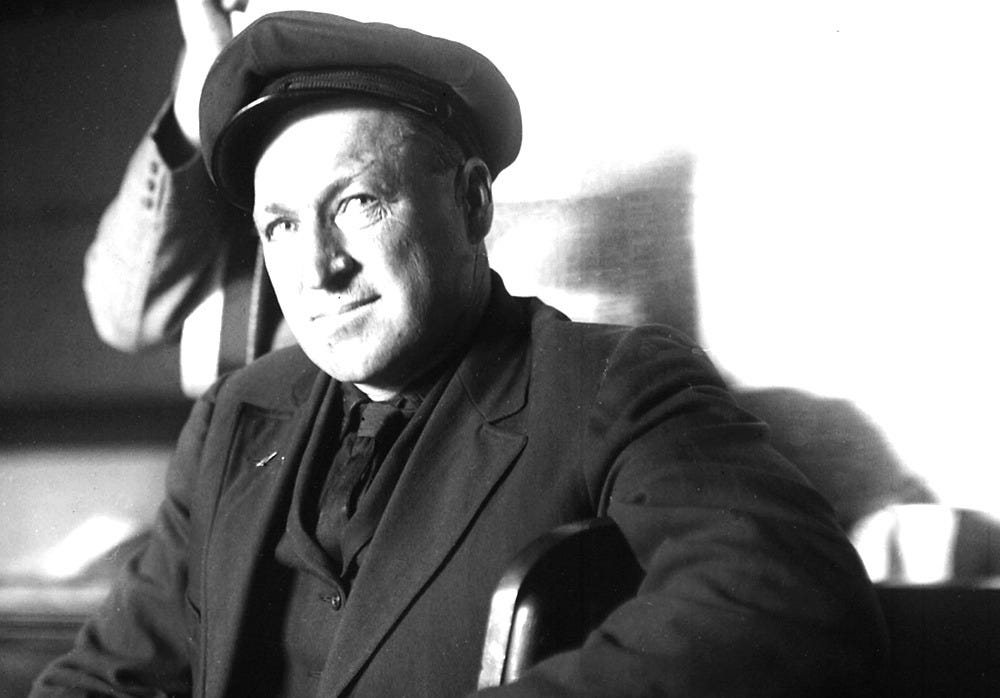
The trouble had started a few weeks earlier, on June 11, 1908, when Seavey had come across the schooner Nellie Johnson docked at Grand Haven, Michigan, with a load of cedar posts, and apparently found the sight of a ready load of cargo too enticing to resist. Seavey and a couple of crewmen sailed away with the Nellie Johnson and tried unsuccessfully to sell the cargo before at some point abandoning the effort. They eventually stashed the boat in a river in Frankfort, Michigan, where she was later found with six feet of water in her hold.
The Johnson’s captain, R. J. McCormick, reported her missing a few days later, and on June 22, McCormick and federal Deputy Marshall Thomas Currier were received on board the United States revenue cutter Tuscarora to attempt to recover the stolen vessel. Seavey continued to evade authorities for a few days, until on the afternoon of Saturday, June 27, his schooner, the Wanderer, was finally sighted a few miles off the coast of Frankfort. The ensuing chase lasted for about an hour. Seavey’s crew caught a good breeze, but they were no match for the steam engine of the government cutter. Within a couple of hours, the Tuscarora, under the command of Captain U. H. Uberroth, had erased the Wanderer’s lead.
Contemporaneous newspaper accounts claimed that the Tuscarora fired a cannonball over the deck of the Wanderer, finally forcing Seavey’s surrender and ending the chase. However, Seavey biographer Richard Boyd examined the Tuscarora’s log book and found that while the capture of Seavey is indeed recorded, no mention was made of a shot having been fired.1
Whatever the case may be, the Wanderer was boarded and Seavey was placed under arrest by Deputy Marshall Currier. Fortunately for Seavey, the specific charge laid against him was not piracy, which could potentially have carried a death sentence, but a lesser charge of mutiny (though the circumstances are unclear, he had apparently once been a member of McCormick’s crew), punishable by a maximum of $10,000 or ten years of hard labor. (Even this charge was eventually dropped.)
Dramatic retellings of the incident made the front page of major newspapers including the New York Times and the Chicago Daily News, firmly establishing Seavey’s reputation as a “pirate” of the Great Lakes.2 While he is largely unknown in his native Maine, Roaring Dan Seavey, as he is often called, has acquired a kind of legendary status in the Great Lakes region. He has been featured in magazine articles, museum exhibits, public lectures, and radio programs. A distillery in Milwaukee, Wisconsin, even makes a “Roaring Dan’s” maple-flavored rum.
Unsurprisingly, popular accounts of Dan’s life have tended to freely mix documented facts with dubious anecdotes. Many stories about Dan Seavey come from interviews with the man himself—an unreliable narrator of his own life if ever there was one. Other stories appeared in newspaper articles in the years following his death and were related by people who had once crossed paths with him.
Truth and legend will probably always be entangled in the stories of Roaring Dan’s heyday and any historian committed to getting to the bottom of everything would face an almost Herculean task.3 The much more modest aim of this article is simply to introduce Dan to western Maine audiences and to correct two deficiencies commonly found in accounts of his early life, one a factual error and the other an omission.
Roaring Dan’s biographers have mostly accepted the statement which appears in his obituary that he was born in Portland, Maine, on March 23, 1865. While the month and day could be accurate, the year and location are almost certainly not. All available evidence suggests Dan was born in Bethel, Maine, around 1869. Furthermore, most if not all of those who have written about Seavey to this point have missed the story of one of Dan’s earliest exploits: his arrest on counterfeiting charges in Portland in 1896.
Family Background and Early Life
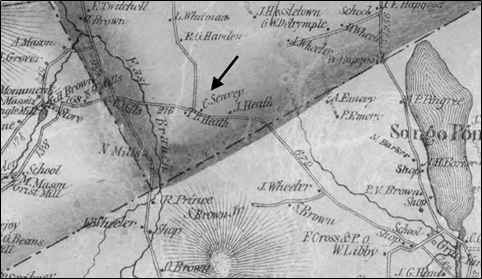
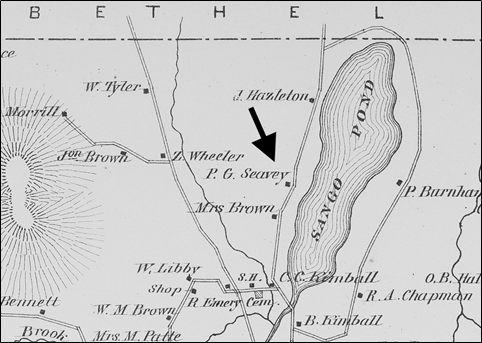
Early in the nineteenth century, Roaring Dan Seavey’s great-grandfather, Clement Seavey, moved from New Hampshire to Gilead, where his sixth child (of at least fourteen), also named Clement Seavey, was born in 1807.4 Around 1823, Clement Sr. moved to Bethel, where he set up a homestead on the Grover Hill Road at the corner of a now-abandoned road which then led to Albany.5
The younger Clement Seavey, Dan’s grandfather, later occupied his father’s homestead. He married Jeanette Rowell and had numerous children, including Clement Porter Seavey, known as Porter, born July 24, 1846.6
Porter and his first wife, Josephine Ward, were married on January 25, 1868, by local Justice of the Peace Jacob H. Lovejoy. Their marriage was recorded in an Albany record book and also noted by Lovejoy in his diary.7 They had two children, Dan, and his sister, Jeanette or Jennie, born sometime from 1870-72. Porter, Josephine (listed as “Catherine J.”), and baby Daniel are found living in Bethel on the 1870 census, probably somewhere on Grover Hill in the vicinity of Clement Seavey’s homestead near the Bethel-Albany town line.8
Josephine died on October 7, 1872, the result of a tragic accident. She was awakened in the early morning by one of the children crying. While she was lighting a lamp, a bottle of camphor fell from a shelf above, spilled on her, and was ignited by the match. She suffered severe burns and lived only until 8:00 in the evening. Her body was laid to rest in Grover Hill Cemetery.9
Porter married his second wife, Alice F. Page, on March 26, 1877, with Lovejoy again officiating. At the time of the 1880 census, eleven-year-old Dan Seavey could still be found living with his father and stepmother, now in Albany. A newspaper column from the time notes that their house burned that August, during the middle of a severe drought.10
Jennie’s whereabouts in 1880 remain a complete mystery. No trace can be found of her in Bethel or Albany records. It’s possible that she was sent to live with a relative after Josephine’s death, but all that can be confirmed is that within the next decade or so she had moved to the Midwest and married someone by the last name Thomas with whom she reportedly had two children.
By his own account, Dan ran away from home around age thirteen. Dan told many stories about this time, most notably in a 1930 interview with the Escanaba Daily Press. If he is to be believed, he joined the navy and served for thirty-two months before going to work for the Indian Affairs service in Wisconsin and Oklahoma. Dan told of going to Alaska in 1888 after buying a tenth share in a mining company, the $10,000 for which he scraped together by selling two saloons and a farm on the outskirts of Milwaukee. The Alaskan adventure turned out to be a bust and Seavey said he came back broke. It was upon his return, Seavey said, that he settled in Escanaba, Michigan (where he would live on and off for the rest of his life), and began captaining ships and running a freight boat service.11
About this time, Dan married his first wife Mary O. Plumley. While the exact date of their marriage is unclear, their two children, Harriet and Josephine Orpha, were born on August 6, 1889, and September 16, 1890, respectively.12
Some of the autobiographical details given by Seavey to the Escanaba newspaper seem plausible, though others are more doubtful. No record has been found of his naval service, though it is not altogether impossible, given the many testimonies to his imposing physical stature, that he could have passed as an adult while still a young teenager. (This might even explain some of the confusion over his birth year.) But whether or not he told the truth generally, he understandably omitted at least one embarrassing part of the story.
The Counterfeiting Case
On Saturday, May 23, 1896, a grocer in Portland, Maine, alerted authorities that a man had tried to pass off a counterfeit silver dollar. A deputy marshal directed police to arrest the man, Daniel W. Seavey, who was brought into the station for questioning and claimed to have received the dollar from a man who had changed a five-dollar bill for him. When he was unable to provide satisfactory details, a search was made of the 5 Vine Street residence at which he was living. There, officers found a genuine 1881 silver dollar, a die, and a small amount of white metal and aluminum, a bag of plaster of Paris, and two glass tumblers. Dan maintained his story about having received the dollar from another man and insisted the die was not intended to be used for counterfeiting, but instead for producing “tokens.” Dan’s sister, Jennie B. Thomas, was also arrested.13
On Monday, Dan was arraigned before U.S. Commissioner Bradley and put under $1000 bond, while bond for Jennie was set at $300. In the days that followed, more details began to appear in the newspapers. It was reported that Dan and Jennie had been residing in Wisconsin before coming to Portland in February. In contrast to the accounts that would be published much later, Dan’s age at the time (twenty-seven) was correctly stated as was the fact that the siblings were originally from Bethel. A cousin in Portland was sent to Norway, where their father was now living, to try to enlist some aid on their behalf.
Strange allegations were also published concerning the nature of the relationship between the two siblings. It was claimed that they had met by chance out west after not seeing each other since childhood and that an “infatuation took possession of them.” Each was said to have left their spouse and children for the purpose of being together. According to one report, when they first arrived in Maine, they had lived with a cousin. The cousin soon objected to the “nature of their attention toward each other,” and they moved into the single room, sparsely-furnished home where the counterfeiting equipment was found, apparently eking out a meager existence.14
It is difficult to know just how much to credit the details of these accounts. When a reporter for the Bangor Commercial visited Dan a week later, he was said to be very bitter at the Portland newspapers, which he claimed had “been slandering him dreadfully.” Some of what Dan and Jennie told the Commercial is consistent with other accounts, including that he had run a saloon in the West and had worked hunting and trapping and as a guide. Dan also claimed to have worked for several newspapers, though his sister claimed no knowledge of that. Dan was described as tall and “powerfully built,” with a faint mustache and “large, laughing eyes.”15
It is unclear whether Dan served any additional time on the counterfeiting charge beyond that awaiting trial, but he and Jennie moved back out west after it was over. Four years later, in June of 1900, Dan and Jennie could still be found living together in Crystal Lake, Michigan. Shortly thereafter, however, they parted ways. Dan married his second wife, Zilda May Bisner, on January 28, 1901.16
Jennie married Paul Dawson on July 7, 1903, in Windsor, Ontario, just across the border from Detroit, where she was then living. In 1907, they moved to Delray Beach, Florida, where she became active in community life as a member of the Presbyterian Church and a Worthy Matron of the Order of the Eastern Star. Porter Seavey’s obituary notes that Jennie’s father came to stay with her one winter near the end of his life, but he apparently disliked the Florida climate. Jennie died at her Delray Beach home on November 3, 1946, at the age of 76.17
While his sister may have successfully moved on with her life and put aside the unseemly aspects of her past, Dan was just getting started.
The Legend is Born
Dan purchased the Wanderer in 1900 for $600.18 From this point on it becomes even more difficult to separate the myth from the man. A great many stories are told about his career as a sailor, testifying to a wide range of endeavors ranging from legitimate enterprises, to shady business practices, to entirely illicit activities.
Among the many activities Dan was said to have engaged in were poaching, smuggling, rum-running, stealing of cargo from other ships, and possibly even the provision of gambling and prostitution services. Dan was also well-known as a fighter. He was said to have taken part in many a drunken brawl and even a few prearranged prizefights, which, tradition has it, he nearly always won.19
Given this reputation, it is unsurprising that Dan was soon separated from his second wife as well. A complaint filed by Zilda in 1905 describes his drunken tirades, abuse, and violent threats made against her. She was finally granted a divorce in July of 1907, with desertion as the reason cited.20 His third marriage, to Annie Bradley, finally stuck, lasting from about 1912 until her death in 1928. Dan also eventually reconciled with one of his daughters from his first marriage, Josephine, with whom he lived later in life.21
In addition to the 1908 “piracy” case, one other incident in particular has captured imaginations. By 1915, Dan had been operating for several years a sawmill on Gouley’s Harbor near Garden, Michigan. That May, he contracted with the Brody family to saw some timber for them at Fairport, Michigan. Robert Brody’s two sons, Robert, 15, and James, 18, had been at Dan’s place on Sunday, May 30, to assist him in loading equipment onto one of his boats, the R. P. Mason. At about midnight, a fire broke out in the sawmill. As soon as the flames were discovered James Brody rushed into Dan’s attached home, where Dan was still fast asleep. James’ quick action saved Dan, who was able to survive by immediately jumping out a window. But the fire had already significantly progressed by this point and James did not make it out alive. Lucius Mercier, Dan’s business partner, also perished while attempting to lead one of his favorite boats away from the harbor.22
In the wake of the tragedy, fresh rumors began to circulate, partly spurred by initial statements from officials and by sensational (or just plainly inaccurate) press coverage. Foul play was originally suspected, and shots were reported to have been fired.23 Theories included that Dan had intentionally set the fire or had shot James Brody. Later investigations however, found that Dan’s account was believed to be the most plausible, that “bullets” found in Brody’s neck were actually lead sinkers from fishnets that melted and burned their way in, and that the shots heard were cartridges exploding due to the intense heat. Some intrigue still surrounds the fire, as a few weeks later an investigation resulted in the arrest of a Garden resident, John Mills, with whom Seavey allegedly had bad blood. Mills was eventually let go for insufficient evidence.24
Along with the Wanderer, and his sawmill boat the R. P. Mason (lost during the fire), Dan owned several other ships throughout the course of his career. These included the Harvey Ransom, and the Mary Alice.25 In his 1930 interview, Dan said he sold the Mary Alice and gave up sailing in 1927, the primary reason being paralysis in his right arm from burns sustained during a gasoline explosion on his boat. The last decades of his life were quieter. When Escanaba Daily Press columnist Clint Dunathan first began publishing Seavey legends in 1945, he was unsure whether Dan was even still alive.26
In fact, Dan was still hanging in—but not for much longer. He died on February 14, 1949, at the Eklund convalescent home at Peshtigo, Michigan.27 Following the publication of Seavey’s obituary, even more stories began to pour in from those who had either known Dan or heard stories secondhand, keeping Dunathan well supplied with material for future issues.
These anecdotes give a sense of the often contradictory portrayals of Dan’s character and personality. While Dan was known to be capable of violence, hard drinking, and criminality, many stories attempt to rescue his reputation somewhat, noting his occasional acts of personal generosity, and especially his soft spot for young people. One tells of a time that Dan made two valiant efforts at diving into deep water in an unsuccessful attempt to save a young man from drowning. In another instance, Dan is said to have turned the tables on a father who gave his son a whipping after catching the boy sneaking off to the dock to visit Dan and hear his stories. Dan supposedly hoisted the grown man upside down and gave him his own spanking. A former Escanaba resident who had lived near Seavey wrote in to the Press to recall the time that, as a young girl, she had been struggling home during a snowstorm with a doll buggy when she passed Dan’s house. Seeing her, Dan hoisted the buggy under one arm and, taking her by the hand, helped her the rest of the way home.28
Seavey returned to Maine at least one time. In October of 1919, a local news column briefly noted that he had been in Norway settling his father’s estate.29 This was probably his last visit to the area, and the local papers seem to have carried no mention of his passing. Daniel Seavey’s wild journey through life had brought him a long way from his boyhood in the woods of Bethel, Maine. But it was here on Grover Hill, just a little way from the Albany town line, where Roaring Dan got his start in the world, and it is likely in the waters of nearby Songo Pond that the Great Lakes pirate first learned to swim.
Richard Boyd, A Pirate Roams Lake Michigan: The Dan Seavey Story (Wisconsin Underwater Archeology Association, 2010), 6-13.
The most detailed and lively account appeared in the Chicago Inter Ocean, June 30, 1908.
Readers interested in the legends surrounding Dan Seavey should see Boyd, A Pirate Roams Lake Michigan. Boyd’s booklet is highly entertaining and provides documentation for some key facts, including details from the Tuscarora’s official logbook. However, it does also contain a number of thinly-sourced “Seavey Stories” of questionable veracity. Another biography, Great Lakes Pirate: The Adventures of Roaring Dan Seavey by Gavin Schmitt, is scheduled to be published by the History Press on April 26, 2021. Schmitt’s work promises to go further in sifting history from folklore.
Gilead, Me., “Vital records, 1805-1904,” database with images, FamilySearch.org.
For a description of this site, see Mary C. Keniston and Randall H. Bennett, “Grover Hill,” The Bethel Courier 18, no. 2 (Summer 1994): 8-9.
Death record for Porter C. Seavey, October 7, 1919, “Maine, U.S., Death Records, 1761-1922,” database with images, Ancestry.com.
Albany, Maine, intentions of marriage, 1805-1870, COLL 21.1.7, Box 1, Folder 4, Town Records of Albany, Museums of the Bethel Historical Society, Bethel, Maine; Jacob H. Lovejoy, The Diaries of Jacob Holt Lovejoy (1812-1893) of Albany, Maine, ed. Michael S. Stowell (Privately printed, 2017), 87.
1870 United States Census, Bethel, Oxford County, Maine, Ancestry.com.
Oxford Democrat, November 12, 1872; Bethel, Maine, Cemeteries: A Listing of Gravestone Inscriptions, comp. Agnes H. Haines and Mildred O. Jackson (Bethel, Maine: Bethel Historical Society, 1989), 90.
Oxford Democrat, April 10, 1877; Lovejoy, Diaries, 131; 1880 United States Census, Albany, Oxford County, Maine, Ancestry.com; Oxford Democrat, August 31, 1880.
Escanaba Daily Press, February 9, 1930. This article gives his birth date as March 23, 1859. In this case the interviewer probably just misheard the decade.
Certificate of death for Harriet Blanche Broed, September 15, 1936, “Michigan, U.S., Death Records, 1867-1952,” database with images, Ancestry.com; Social Security death record for Josephine Wood, “U.S., Social Security Death Index, 1935-2014,” database, Ancestry.com.
Portland Daily Press, May 25, 1896; Boston Herald, May 24, 1896.
Portland Daily Press, May 26, 1896, May 27, 1896; Boston Herald, May 27, 1896.
Bangor Commercial article quoted in the Portland Daily Press, June 5, 1896.
1900 United States Census, Crystal Lake Township, Benzie County, Michigan, Ancestry.com; “Michigan, U.S., Marriage Records, 1867-1952,” database with images, Ancestry.com.
“Ontario, Canada, Marriages, 1826-1938,” database with images, Ancestry.com; Oxford Democrat, October 3, 1919; Palm Beach Post, November 4, 1946.
Muskegon (Mich.) Chronicle, December 14, 1900.
Boyd, A Pirate Roams Lake Michigan, 23, 5.
Boyd, A Pirate Roams Lake Michigan, 4. “Michigan, Divorce Records, 1897-1952,” database with images, Ancestry.com.
Boyd, A Pirate Roams Lake Michigan, 4, 20.
Escanaba Morning Press, June 2, 1915.
Escanaba Morning Press, June 3, 1915. Although local press coverage was somewhat better, an Associated Press article which was widely reprinted throughout the region even misstated Dan as being among the dead. (E.g. Lansing State Journal, June 1, 1915; Green Bay Press-Gazette, June 1, 1915.)
Muskegon Chronicle, June 3, 1915; Escanaba Daily Mirror, June 14, 1915; Boyd, A Pirate Roams Lake Michigan, 16-19. See Boyd for further speculation regarding the circumstances surrounding the fire.
For descriptions of these ships, including images of most of them, see Boyd, A Pirate Roams Lake Michigan, 14-17.
Escanaba Daily Press, November 11, 1945.
Escanaba Daily Press, February 25, 1949.
Escanaba Daily Press, March 1, 12, September 19, 1949.
Oxford Democrat, October 14, 1919.