


Goose Eye No. 1 (2021)
Book Review
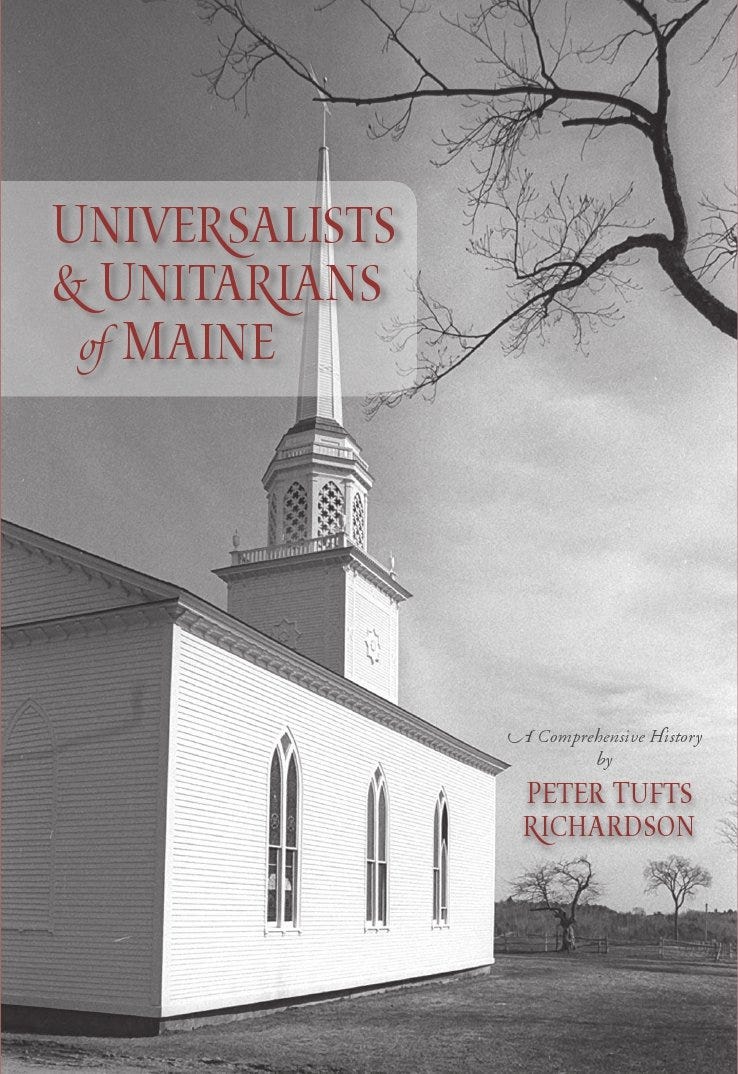
Universalists and Unitarians of Maine: A Comprehensive History. By Peter Tufts Richardson. (Rockland, Maine: Red Barn Publishing, 2017. Pp. vii. 686. Cloth $69.95.)
Universalist doctrines were first preached in Maine in 1799, when a group of five Norway and two Paris men raised enough money to purchase a farm in Poland for Rev. Thomas Barnes and his family. From this site, Barnes, while ministering every fourth Sunday at Norway, was able to spread out to many nearby communities, helping to start congregations in many towns. Among these were New Gloucester, Gray, and Falmouth (Portland), which together with the congregation in Norway and Paris formed the new Eastern Association of Universalists in 1799.
Along with Unitarianism, Universalism is one of the two main foundations for the modern religion of Unitarian Universalism. The American Unitarian Association and the Universalist Church of America merged in 1961, forming the Unitarian Universalist Association, which draws from its liberal Christian roots, among many other sources of inspiration. For much of their early history, however, these two faiths followed somewhat different paths.
In Maine, Unitarianism made its presence most felt in the larger cities and coastal communities. In places such as Portland, Kennebunk, and Belfast, liberal-minded reformers and intellectuals arrived from Boston and Cambridge bringing with them the faith of Ralph Waldo Emerson and Louisa May Alcott. Many leading men of the state were Unitarians, including Maine’s first governor, William King, but its strength largely remained concentrated in more affluent parts of the state.
Universalism, by contrast, spread deep into the interior, growing to become the fourth largest Christian sect in the state, and winning converts from the more established Methodists, Baptists, and Congregationalists. Universalism was chiefly distinguished from other branches of Christianity by adherence to the doctrine of universal reconciliation—the belief that all members of humanity will eventually enter heaven. Though considered heretical by many members of more mainstream sects, this was not without appeal to those who had carried the spirit of live and let live with them to the hinterlands. As Peter Tufts Richardson observes in Universalists and Unitarians of Maine, “there is something in the nature of a frontier that sponsored an openness to liberal, even radical, ideas.” It seems that for at least some of Maine’s independent-minded settlers the concept of universalism jibed with their democratic ideals. By 1820, there were 16 Universalist societies, most of them traceable back to Thomas Barnes. In the 1820s 45 more were founded, and 71 more in the 1830s.
According to Richardson, seventeen of Maine’s governors have been either Unitarians or Universalists, including more than half of the first twenty-five, along with numerous judges and members of the state legislature. Yet despite the seemingly clear significance of these facts, the history and influence of both faiths in Maine had long been understudied. This is not to say writing on the history Unitarianism and Universalism in Maine has been completely absent. A 62-page booklet, The Maine Universalist Convention: A Brief History, by James E. Philoon, was issued in 1929, and, in 1953, Harold C. Perham compiled The Maine Book on Universalism, a rather eccentric volume containing a mix of history, biography, photographs of people and buildings, and interpretations of religious doctrine. In 1951 Lawrence F. Small completed a master’s thesis entitled, Unitarianism Down-East: A Study of the Movement in Maine, and in 2011 David Raymond published “Echoes of a Distant Thunder?: The Unitarian Controversy in Maine, 1734-1833” in the journal Maine History. There have doubtless also been a handful of other academic works or essays in specialist publications which have escaped this reviewer’s notice. However, neither Universalism nor Unitarianism was ever the subject of a large nineteenth-century compilation comparable to Rev. Stephen Allen’s two-volume History of Methodism in Maine, 1793-1886, first published in 1887. Nor did the succeeding century produce any rigorous attempt to correct for this deficit. Simply put, there was no definitive account to which one might turn for either a basic overview or to seek the answer to some burning question.
That changed in 2017 with publication of Richardson’s book, the first major work of scholarship on Universalism, Unitarianism, and Unitarian Universalism in Maine. A true labor of love, this remarkable volume is the culmination of several decades of research on the part of the author and will serve as the standard resource for many decades to come. Richardson has documented nearly all aspects of the history and influence of the liberal religious tradition in the counties and towns of our state. These efforts are not limited to groups of Unitarians and Universalists who erected their own churches or even necessarily those who established organized societies. Wherever and whenever evidence of Unitarian or Universalist activity could be found, Richardson has recorded it. These 409 stories range from very brief (a couple of sentences) to several pages in length.
Universalists and Unitarians of Maine will be of particular interest to readers in Oxford County, given the important role this region has played in the history of Universalism in Maine. In addition to Thomas Barnes, one would be remiss not to mention Norway’s native son, Sylvanus Cobb. Born in 1798, the year before Barnes’ arrival, Cobb was raised Baptist but was converted away through his self-study of the Bible. In 1817, Cobb found a job as a schoolteacher in Waterford. Lincoln Ripley, the school superintendent and Congregationalist minister who examined him, approved his teaching license but added that despite his qualifications, he “would not consistently commit a child to the care of one of his religious sentiments.” Several parents in the community were supporters of Cobb, however, and this proved just the inspiration needed to get a Universalist Church going in Waterford. Cobb moved to Waterville and helped found numerous churches in eastern Maine. Richardson estimates that he preached in at least half of the societies founded in the 1820s.
The town of Woodstock gave the world Sidney Perham, a member of the United States House of Representatives from 1863-1839 and the 33rd Governor of Maine from 1871-1874. Born to Joel and Sophronia Bisbee Perham in 1819, Sidney Perham was among the founders of the Universalist society in Woodstock in 1843 and served as its first clerk. He helped raise funds to erect the Universalist Church in the village of Bryant Pond in 1852-3, and is buried in the adjacent Lakeside Cemetery. Perham was a prominent advocate of temperance, a cause linked strongly with his religious convictions. He was a long time member of the board of trustees for the Universalist General Convention and served at various times as the president of both the national and state governing bodies.
In the more recent past, Harold C. Perham, compiler of the aforementioned Maine Book on Universalism, was a prominent Universalist lay preacher who called West Paris home. A final word should also be added here for Harold’s son, Joseph Perham. Joe was a lay preacher himself and spoke at various times before many Maine congregations, but he is perhaps best remembered as a beloved teacher and as a humorist and storyteller. Many of his folksy recordings chronicling rural Maine life, such as “That Wonderful Old Two Holer,” are still available.
As the publisher of Universalists and Unitarians of Maine, as well as its author, Richardson has made a few choices which may have somewhat limited the potential audience for the book. All pages are printed on a thick, coated paper stock that greatly enhances the quality of the illustrations but has yielded a final product which is both heavy and expensive. This is especially noticeable given that no paperback option has thus far been made available. Chapters are arranged by county and subdivided by town, giving it more the nature of an encyclopedia than a book which can easily be read from start to finish. Either chronological or thematic arrangement could have resulted in a more readable narrative. (The final chapter, “Dynamics,” somewhat makes up for this.)
Still, it is hard to fault the author too much for these decisions. A different system of arrangement would have meant its own set of trade-offs. Likewise, the book is an unquestionably beautiful production. The photographs look great and there are a lot of them—more than 400, some in color—mostly taken by the author himself.
While Richardson has gone an impressively long way toward achieving what he set out to do, compiling a comprehensive history, hopefully it will be far from the last word ever published on the subject. Instead let it be a reminder of the richness and breadth of the liberal religious tradition in Maine and serve as in inspiration for others to dive deeper still. Nearly every individual story in the book could be expanded on by local historians in those communities, and many topics and themes touched upon could be fruitfully taken up by students and academics. Any subsequent research will, of necessity, build off of Richardson’s work, and for this all future scholars owe him an enormous debt of gratitude.
William F. Chapman
Museums of the Bethel Historical Society