

This is the third in a series of letters written from the 1876 Centennial International Exhibition by Sarah Ellen Shaw and originally published in the Oxford Democrat newspaper. You can read Part 1 and 2 here and here.
Oxford Democrat, July 11, 1876
Centennial Letter, No. 3.
BY S. E. S.
FIFTH AVENUE HOTEL.
Phila., Pa.
Our third day in the Exhibition was devoted to the Art Gallery or Memorial Hall—a magnificent structure of white marble, with a dome like the State House, which building, though lofty and spacious, was found to be incapable of containing the exhibits of art sent in from ail quarters of the globe; and it was deemed necessary to construct an Annex Building containing forty-five rooms, each about forty feet square. We do not pretend to criticise or even to attempt any description of these works of art. We could only give a hasty look at the paintings and sculpture from Italy, Spain, France, England, Canada and other countries, but we confess we loved to linger most among the works of our own American artists, where there was nothing to shock the eye or the taste and much to attract and delight. Among the paintings exhibited by the U.S. we noticed only two from our own State. These were “On the Coast of Maine,” by Harry Brown, and Holmes’s large landscape “Near the Adirondacks.”1 It was impossible to do justice to this department in the short time we had to devote to it; and we would have loved to spend weeks in a careful study of the various and wonderful displays of art here exhibited. Though there is much that is atrocious and indecent, there is more that is pleasing, ennobling and elevating.
The Annex to the Main Building contains carriages of every description, from different countries, some of them harnessed to stuffed horses that looked as if alive and just ready for a start. There were elegant private carriages that might have been constructed for kings and queens so richly were they upholstered and finished, and baby carriages of wonderful structure and elegance, among which we noticed a combined carriage and cradle with a canopy, reversible top, shifting handle and reversible body. Some of the vehicles from foreign countries were extravagantly luxurious, while others were strangely uncouth. Some had the driver’s seat on the back of the carriage high up above the heads of the occupants so that all he could see was the top of the horses’ heads. One of the beautiful Italian carriages was put to a strange use. It was something like a cab and was upholstered with delicate blue satin which cost twenty dollars a yard. While the exhibitor was absent at noon, an Irish woman with five little children conceived this to be a nice place for them to dine—so she opened the doors and took her little family within and they had a fine pic-nic all to themselves. The wrath of the exhibitor on his return can be better imagined than described.
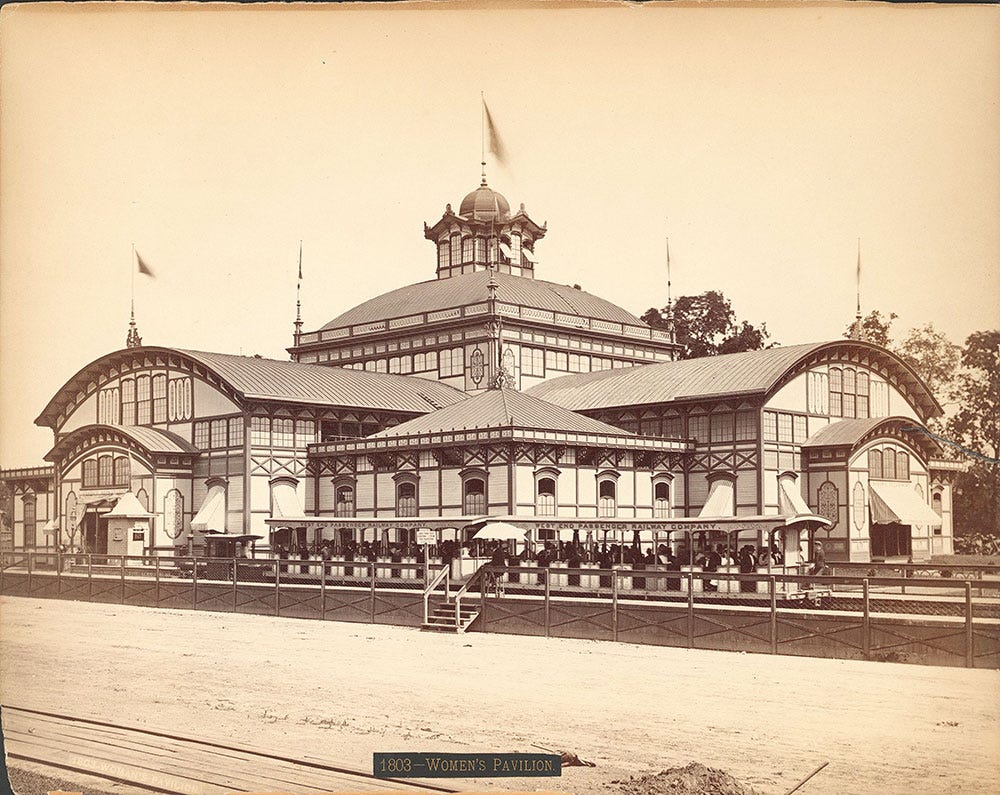
The Woman’s Pavilion was our next place of resort. Here we found all kinds of work performed by women, embroideries, carvings, straw work, bead work, and the like—very much like what is seen at our county fairs, though on a much broader scale. Here were seen contributions from the royal family of England, such as etchings by the Queen, table napkins spun by the royal hands, s table cloth and a banner screen embroidered by Princesses, and drawings of flowers by the Marchioness of Lorne.
Horticultural Hall next demanded our attention. Here we found all kinds of foliage with fountains and statuary, dried flowers and grasses, straw ornaments, and natural flowers preserved without the aid of wax, sent by California. There were lovely wreaths, holding their natural colors, and looking as fresh as if just made. Outside of this building, under a huge tent cover, were beautiful Rhododendrons of ever variety of color making a magnificent display. Other flowers and plants were growing outside in large gardens laid out with a great taste and beauty.
Agricultural Hall with its green roof next attracted our attention. Here were spices, fruits, confections and seeds of all kinds arranged in pavilions, arches, conical pyramids and other curious structures—a palace of wool, a cracker edifice, immense soda fountains with beautiful statuary. One corn start manufacturer had his boxes arranged very artistically. In front of his pavilion was a huge pedestal surmounted by a marble group of statues as large as life, revolving in one direction, while in an outer circle, flower pots and cans of starch revolved in the opposite direction.
New Jersey exhibited huge strawberries, any one of which would make two bites. The large glass jars of pickles, fruit, oysters, &c., were enough to make housekeepers open their eyes with wonder and delight. When we passed the spice exhibit, the air seemed filled with “odors from Araby the blest.”
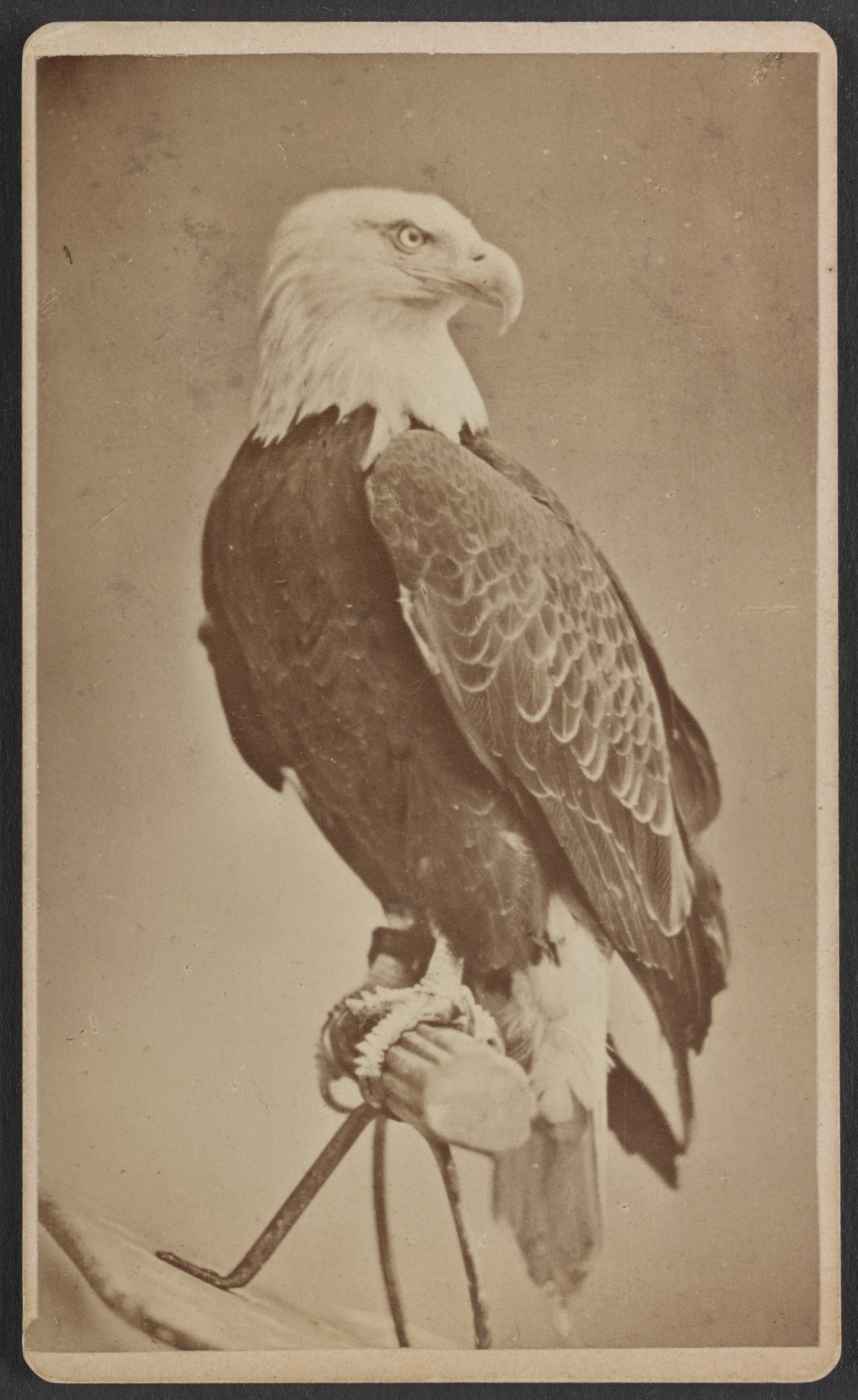
All along one end of this building were great numbers of aquaria filled with all kinds of small fish, eels, king-crabs, sea turtles, &c. There was an immense tank of water filled with full rigged sailing vessels and boats, representing the Gloucester fisheries, with a wharf in one corner such as was constructed 100 years ago, and in another corner one of the present day. On shelves near by were arranged different models of articles used from the year 1800 to this time—also trophies taken by the fishermen, among which were corals and rocks that came up on their lines from 900 ft. below the surface of the water, curious shells, seaweed and sponges. In this hall we saw the veritable eagle “Old Abe,” who went through the late war with distinguished honors.
The Glass building we did not enter; but it presents a very attractive outside, with its numerous bright glass balls, of ever color, all around the edge of the large roof.
The Government Building engrossed one day of our time, and we left it then reluctantly. As you enter the building you come upon the Navy department, in which are portraits of distinguished men and life size wax figures dressed in the costume of a hundred years ago, minute men in white pants, and green coats with brass buttons, warriors in blue and gilt, seamen in their loose uniforms wit their cutlasses in hand, models of vessels full-rigged, miniature three deckers, and boats of every description, all kinds of ammunition, bomb shells some of which are opened to expose the inside, cannon balls, of which some were cracked open and broken from having been fired at iron targets, huge monitors, and all kinds of curiosities collected by the navy—also models of dry docks, representations of the huts in which Greenlanders live in winter, Esquimaux figures, boats, &c.
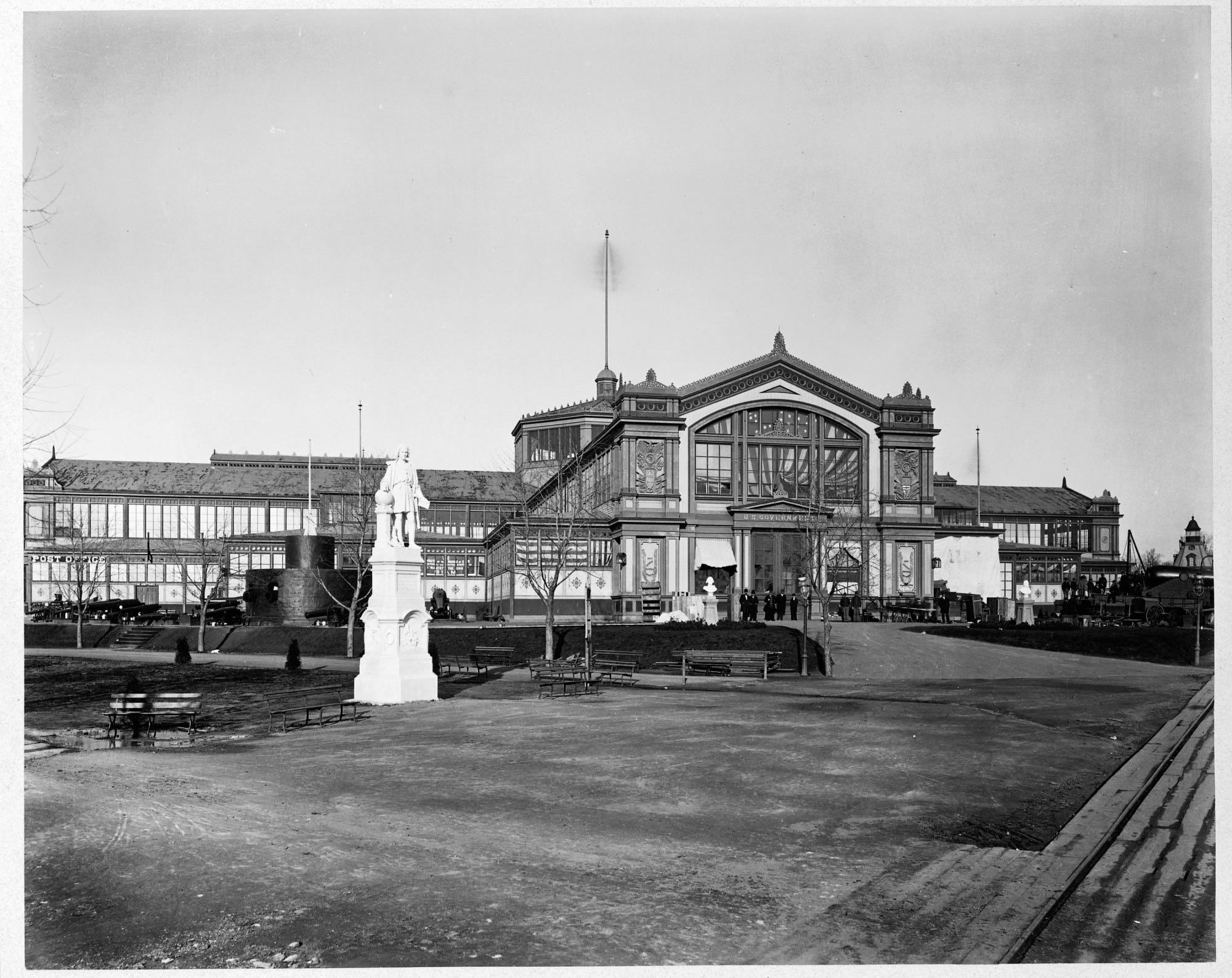
In the Post Office department there were models of fast mail cars, running on rails and showing how they take the U. S. Mail from the various stations, without stopping or slackening their speed. We saw three machines in operation for making envelopes, another for stamping, folding and putting on the mucilage, all of which was done as fast as one could take them up in little bundles and put the bands upon them.
We saw the original ledge of Benj. Franklin, the first Postmaster General of the United States, for the year ending Oct. 5th, 1775, models of wheels and presses, and books of raised letters for the blind.
In the U. S. department of Agriculture were all kinds of wood, pressed flowers and leaves, immense pine cones, wax models of fruit, and all the insects injurious or beneficial to agriculture.
We were made acquainted with numerous barometers, thermometers, hygrometers and all the other ’ometers, and were told how “Old Probabilities” prognosticated the weather.
In the Smithsonian department of this building we saw native copper and iron ores from Michigan, gold and silver ores from Colorado, silver ores from Utah, immense cubes of Vermont marbles, polished and unpolished, Indian manufactures in pottery, beads, furs and feathers; objects of clay in terra cotta from Mexico, wooden images, curiously carved, immense idols, one of which reached to the top of the building and was composed of numerous headed monsters, and other curiosities both modern and antique. We saw copper ore crystalized in the shape of fern leaves, brilliant specimens of different ores from California and geological specimens from other States.
There were hundreds of models of various kinds of fish, life size—immense sharks, torpedo fish, Jew fish, spear, sail and flying fish, and every other kind of fish found in the waters of our own country.
In glass cases were to be seen walrus tusks polished and “scrimshawed” by sailors, articles of all kinds manufactured from pearl shells, pieces of wood showing the ravages of the ship worm, lovely baskets, arrows, flowers, picture frames, and other ornaments, all made of shells.
Then we came upon the stuffed animals, from a wee mouse to a huge buffalo. There were the Polar and the grizzly bear, the elk, large seals and little baby seals, walruses, immense sea-lions, a white whale, huge leather-backed turtles, crocodiles and other sea monsters.
In the light-house department, were huge, revolving light-house lamps, models of light-houses, among which was one of the new Minot’s Ledge light-house built of granite. It has a huge fog bell which is struck by machinery. There were also self-recording thermometers and barometers and coast survey instruments of every kind.
In the war department were portraits of the Secretaries of War and other officials. Among the numerous implements used in that department were buoyant torpedoes in tanks of water. We saw an immense trip hammer forge pounding out the butt plate of muskets. We saw bullets, cartridges and percussion caps made; and we were attracted by a model of the U. S. arsenal, Rock Island, Ill.
We left the Government Building with the resolve that if it were possible we would spend another day in examining its exhibits, and wended our way to Machinery Hall of which we will give you some account in our next letter.
Harrison Bird Brown (1831–1915) of Portland was one of Maine’s most celebrated landscape artists of his day. According to the official, 1876 Centennial Exhibition catalog, the painting he exhibited was entitled, “The East Highlands.” Philip Henry Holmes (1845–1915) was a Maine-born landscape painter. His painting “The Adirondacks from Vermont” appears in the official catalog and corresponds to Shaw’s reference here to “Holmes’s large landscape ‘Near the Adirondacks.’”