

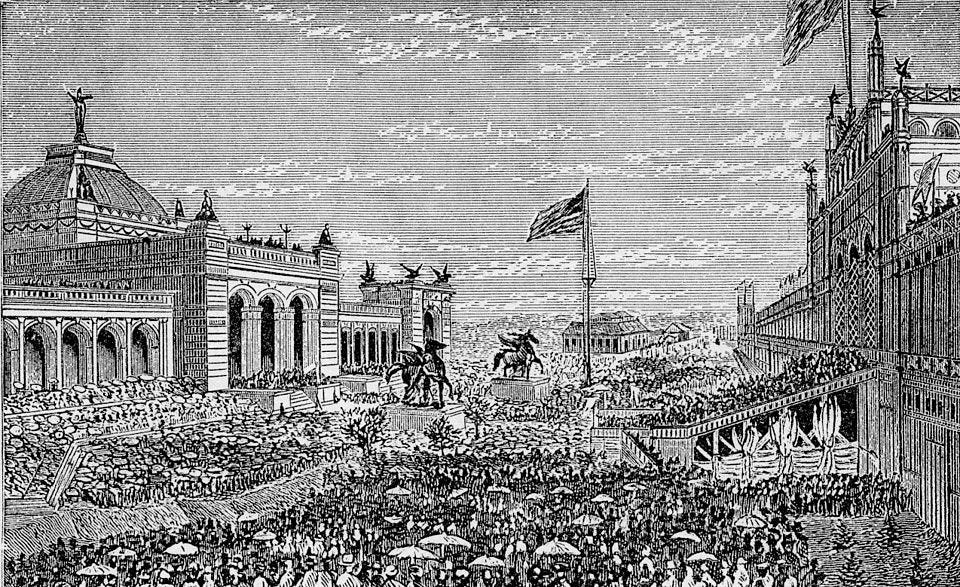
From May 10 to November 10, 1876, a large-scale exposition was held in Philadelphia to commemorate the centennial of the Declaration of Independence’s adoption in Philadelphia on July 4, 1776. Nearly 10 million Americans visited the exposition, and newspapers across the country carried eyewitness accounts from correspondents. From Maine, a delegation of about 50, including many of the state’s newspaper men and their wives went as part of an “editorial excursion.” The Oxford Democrat carried a series of letters from one member of the party, Sarah Ellen Shaw, the wife of former Democrat editor and publisher Col. Frederick Eaton Shaw.1
As part of our year long exploration of the Declaration of Independence and the ways in which its meaning has developed over time, the Independence 250 Committee is also examining the ways in which earlier anniversary’s were celebrated both locally and nationally. Shaw’s letters offer a firsthand account of how Americans encountered industry, art, music, and national identity at the country’s first “world’s fair.” We will be republishing the series in weekly installments.
On Saturday, February 21, at 2:00 p.m., Museums of the Bethel Historical Society Executive Director William Chapman will present “Ghosts of Centennials Past,” a program on how the American Centennial of 1876 and Bicentennial of 1976 were celebrated in the Bethel area. The presentation will take place in Howe Exhibit Hall, in the barn of MBHS’s Mason House, and will be free to attend.
Oxford Democrat, June 27, 1876
Centennial Letter, No. 1.
BY S. E. S.
FIFTH AVENUE HOTEL.
PHILADELPHIA, June 10th, 1876.
Mr. Editor:—It is utterly impossible to “do” the Centennial in the short time to which visitors generally limit themselves. One could spend three months here, and then not see all there is of interest. No one can form an adequate conception of the magnitude of the exhibition from the pictorial representations of the buildings, so freely circulated.
We are with the Maine editorial party at the Elm Avenue Hotel, where we are very agreeably entertained, and have the advantage of being near the Centennial grounds. We arrived in P. At noon; and in the afternoon we took the horse cars and rode to the various places of interest to be seen in the city.
The first building which every stranger will wish to see is Independence Hall. The exterior walls of which have been touched up to resemble as nearly as possible their appearance one hundred years ago. Here is where the Declaration of Independence was signed. Nearly all the portraits in this building are of those who figured in the Revolution.
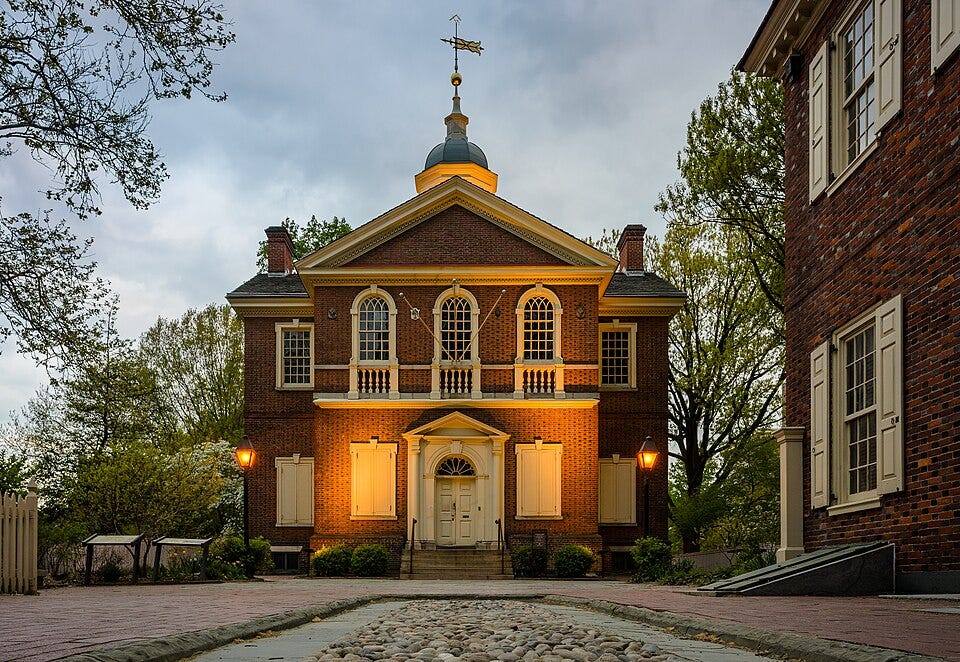
Then there is Carpenter’s Hall, where the first Congress met; the Blind asylum, the Deaf & Dumb asylum, Masonic Temple, Girard College and U. S. Mint, and other places of interest which would require more time than we could devote to them. In the evening a ride round Fairmount Park was very delightful. We called on some of the Mass. editors who were at the Grand Exposition Hotel, put up for this exhibition, and capable of accommodating 4000 guests.
The ride round Fairmount Park gave us a fine view of the exterior of the Exhibition buildings, which are five in number and occupy about 60 acres; 230 acres are used for the whole exhibition. There are a great many other buildings which might be denominated public, such as the U. S. Government Building, Office of Centennial Commission, Women’s Pavilion, &c; and about twenty states have erected edifices of great beauty, which are used as offices, parlors &c. About 150 buildings in all are erected on the grounds.
The first thing to be done on entering the enclosure, is to take the steam cars, in which for 5 cts. you can ride round among the principal structures, for 4 miles, that you may get some idea of their situation, then form your plan for the day, and don’t undertake too much. We spent two whole days in one building, and did not begin to be satisfied, not having seen more than half it contained. The grounds between are laid out in gardens enclosed by iron wickets and ornamented with fountains of every description, huge vases, pillars and memorial statues.
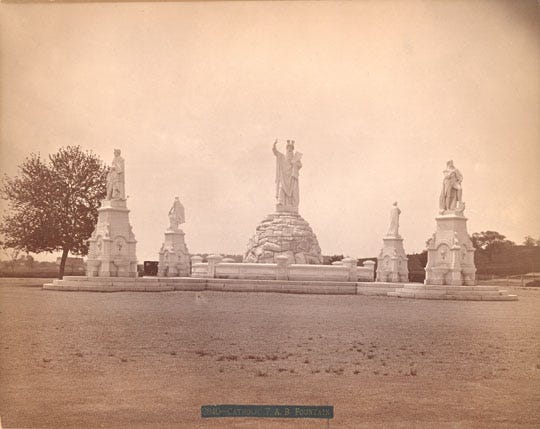
The Centennial Fountain is a large circular basin, 40 feet in diameter and has in its center, a mass of rock-work, surmounted by a colossal statue of Moses, pointing upwards. The French fountain is very striking; and the Catholic Temperance Fountain which is not yet complete, is to be a grand affair.
Every day, both forenoon and afternoon, this week, Gilmore’s Band has given free concerts, at the Music Pavilion, which is in a beautiful grove.2 We understand that Gilmore was told his music was too high an order; and when asked if he could not play something that the common people could appreciate, he replied “No! If they can’t come up to me, I’ll not lower myself to play ten-penny music to them,” in which we think he was right.
Every noon the chime bells ring. We heard them play America, Maryland, Marseille’s Hymn and other national airs.
In the center of the main building is a huge elevator, in which for 10 cts., one can be taken up 101 feet, where if he chooses, he can walk over the top of the building which is one third of a mile long and about 500 ft. wide. In this edifice are many beautiful fountains, rockeries, statues and designs of great interest. Rolling chairs are provided in which for 60 cts. an hour, one may be wheeled round the various buildings. There are settees provided at convenient distances, and ladies’ rooms, where persons will be found to take charge of any garments or articles left with them free of charge.
The grand pianos and organs in the main buildings are played every day, and we heard some fine vocal music whenever we were there. All this is free. Then there are restaurants and cofies with all that can be furnished at a first class hotel, and at many of them, at very reasonable rates. One who wishes to make a thorough survey of this building should obtain a chart such as was published some time since by Harper Bros.
Entering the edifice on the easterly end, we find the Maine Head Quarters at the left; and all the space on the left of the center nave down to the center transept is devoted to the United States.
Everything is so beautifully and artistically arranged, that the effect is wonderfully pleasing. Spools of cotton forming huge pyramids, arches, monuments, towers and domes, diamond shaped, cubical and conical. Eagle pencils so finely grouped as to attract the eye at once. Even such common things as steel screws are fastened on velvet or kid back-grounds in such fanciful shapes as to represent wheels, crowns, crosses and hearts. Palaces of soap, of every variety, shape and color, present a very pretty appearance.
Then we come upon oil carpets arranged in octagonal revolving pyramids.
We were especially attracted by the marble works of the U. S. Among which was the representation of a child asleep, under a lace shawl. One little hand grasped the corner of the shawl above the head, while one foot was thrown out from the covering. The child’s features could be distinctly seen under the marble lace, which we had to touch to be sure that it was really marble.
We passed by a large polished mirror in which we saw a full length reflection of our own person which we hardly recognized; for we were attenuated to the size of a walking stick, like “sweetness long drawn out;” and near by, was another mirror in which we appeared about four time as large as life. We took our friends there to show them how they had been puffed up since they came to the Centennial.
We were much pleased with the exhibits of the zinc and galvanized iron works. There were summer houses of thin wire, which looked like lace network, and garden chairs, bird cages, statues and ornaments for gardens and grounds which are warranted to stand the exposure to heat and rain without rusting.
In one department, we saw a set of furniture made from an old maple tree that grew in Independence Square. The tree was over 100 years old when it was cut down.
There were several enclosures to represent the rooms of a dwelling house, and they were furnished with elegant carpets, pictures, and furniture beautifully upholstered; with fine wainscoting and other interior decorations.
The Phila terra cotta works were particularly attractive.
N. York sends exhibits of huge crystal chandeliers and church metal furniture, ornamental bronzes, and beautiful Palissy ware. Tiffany displays a diamond necklace worth $80,000, and a solitaire worth $15,000.3 We noticed in Tiffany’s department a stand with a top made of Mexican onyx which had been sold for $500.00 to Mrs. Crocker of California.
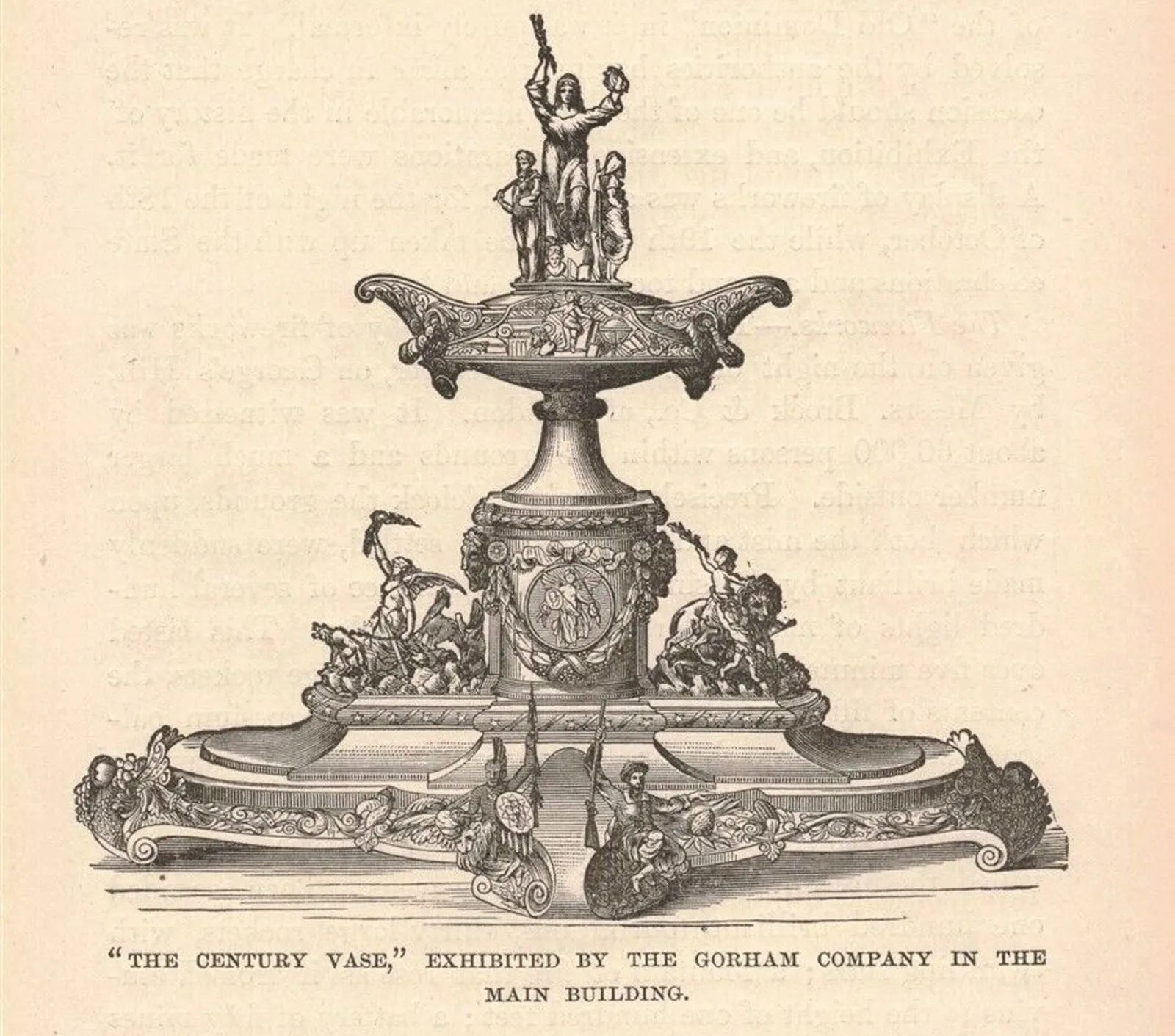
The Gorham Company’s exhibit of silver is very fine. The Century Vase is of solid silver. It is on a slab of polished granite. A band of stars, 38, encircling the piece, 13 in front, represents the present and original number of States in the Union. On one side is the Genius of War, on the other is the Lion led by little children. The medallion in front is the Angel of Fame; on the other side is the Genius of Philosophy. Above this the vase rises, the front and reverse panel of which represents Genius inscribing on the tablet. There are figures denoting Europe, Asia, and Africa bringing in their contributions to the Exhibition, while the central figure America, is welcoming them and asking them to unite with her in celebrating her Centennial year.
Thank you to local historian Christopher Dunham for helping to determine the identity of Sarah Shaw, who is credited only as “S. E. S.” in the published articles.
Composer Patrick S. Gilmore, was sometimes known as the “father of the American concert band.”
$80,000 in 1876 would have approximately the same buying power as $2.5 million in 2025.