

This is the second in a series of letters written from the 1876 Centennial International Exhibition by Sarah Ellen Shaw and originally published in the Oxford Democrat newspaper. You can read Part 1 here. In this second letter, Shaw turns her attention to the foreign exhibits housed within the Main Building. Please be advised that this installment contains a passage expressing overt anti-Chinese racism. We publish this letter in full not to endorse these views, but to confront them directly and avoid misleadingly sanitizing a historical text.
Oxford Democrat, July 4, 1876
Centennial Letter, No. 2.
BY S. E. S.
FIFTH AVENUE HOTEL.
Philadelphia, June 14th, 1876.
Mr. Editor:
In our last we gave you the exhibits of the U.S. in the main building; and we will now offer some account of our second day in this edifice. Next to the U.S. department, on the right, Mexico displayed a fine collection of beautifully polished marble.
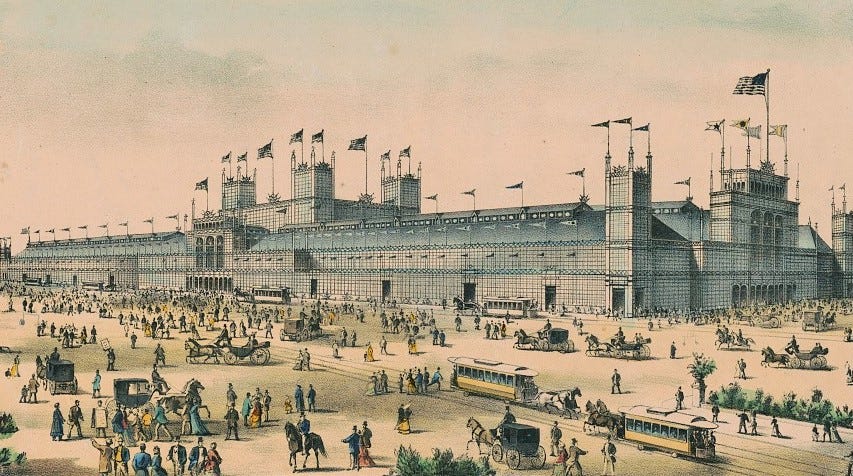
In taking a cursory glance at the exhibits of these different countries, we shall only speak of what we were particularly pleased with, in each one; for, as we said before, it would be impossible to describe all the articles contributed. As one mathematical genius has ascertained, it would take about twenty-three years to survey the whole exhibition, allowing five minutes to each contributor, and using a reasonable number of hours each day.
In the Netherlands department we found a model of a house with a thatched roof, and other models giving some idea of their mode of dress and living.
Brazil has a brilliant display of flowers made entirely of feathers, and some curious insect jewelry made from the bright green beetles and other beautifully colored insects, in gold settings.
The Belgium laces were enough to drive the ladies “raving, distracted, crazy.” They lingered over the lovely delicate fabrics and “oh!-ah”’d” and sighed and broke the 10th commandment; and all the while their liege lords were wondering “what on earth they could see to admire so in those flimsy gewgaws.” There were several wax figures, life size, in full dress. One was very beautifully robed in soft, white grosgrain silk, trimmed elaborately with elegant black lace. Another wore a lovely pale lavender silk, with wide white lace trimmings, and here and there, on the skirt, were little bouquets made of white lace. There were also beautiful silk laces.
The Switzerland embroideries were very fine; and the models of Swiss architecture and the fancy ornaments were exceedingly attractive.
France and her colonies made a fine exhibit of church ornaments, large statues and elegant jewelry, among which was a diamond necklace worth $40,000.
Great Britain had large apartments representing the different rooms of a dwelling house, richly furnished. The beautiful mahogany and satin-wood furniture from London, was particularly noticeable. There was also some ancient furniture on exhibition here. High up above the other exhibits, was a magnificent woven tapestry hanging, representing Christ and the Twelve Apostles, like an oil painting.
Canada had numerous models of public buildings and even whole cities laid out in miniature; and the minerals from that province made an attractive appearance. An inlaid table was here seen, in the top of which were over 100,000 different pieces of wood, all representing a fine picture.
In Jamaica we saw ladies’ hats made of the bark of a tree; and the flowers with which they were trimmed were manufactured from the inside cuticle of the leaf of the tree.
Australia had a huge skeleton of a bird, a great variety of butterflies, immense gold nuggets, and numerous specimens of corals and sea-weed.
India and other colonies had on exhibition a great number of beautiful shells, models of fruits growing in that country, and finely polished wood.
Sweden had several life size groups of figures in wax, showing the habits, customs and modes of dress there, among which groups was a touching representation of Death in the Household. The mother was bending over the couch on which lay the marble form of her little one; and the father sat facing the back of his chair while he held his pipe in his hand. The minister was near with the good Book open in his hand. Near by was the coffin. The mother’s foot protruded from under the folds of her dress and the hob-nailed shoe, with the heel in the middle of the foot, was a curious specimen of cobblers. The countenances of these figures were very natural and life-like, and the cracks and calluses on the father’s hands seemed like real flesh and blood. Another group represented the Old Clockmaker and family. There were also models of Swedish houses, and samples of their furs, among which were some very elegant robes.
Norway also had groups as above. One was of a man riding on a boat-like sledge, made of leather and drawn by a reindeer guided by a single rope, on one side. Wool was spread on the ground to represent snow. Near by, was the wife, walking, and holding under her arm a canoe-shaped leather box, in which was a little babe. The mother’s hair was worn in two long braids down the back. They were all dressed in fur and leather.
Italy exhibits were very striking and beautiful. There were lovely wares, rich mosaics, fine sculptures, shell jewelry, silver filigree ornaments, very nice Leghorn hats, and a large ornamented silver bell which visitors were allowed to strike with the ball which was on the outside, the bell being hung on a framework.
Orange Free State had a large collection of feathers, stuffed birds, insects, etc.1
Peru exhibited mummies, geological specimens and the products peculiar to that region; there was also a singularly recognizable statuette of Gen. Grant and the American eagle, made wholly of wire and placed under a glass globe.
China was rather late in getting her exhibits here, and but a small space was allotted to her in this building. This was filled with unpacked boxes and rubbish the day we were there, and two Chinamen in native costume, with long queues, loose white trousers and shoes with thick, soft white soles, were unpacking and arranging elegant vases and ornaments of wondrous shape, in a huge pyramid. There were also pictures and fans curiously wrought with silk, odd paintings, mosaics, etc. We could but notice the difference between these men and the Japanese of whom we saw several. The latter were fine-looking and intelligent and had adopted our modes of dress, while the former cling to their own costumes and habits with strong pertinacity. They are an inferior race, and their genius is wholly imitative.
[2026 note: Views such as this were unfortunately common during the 1870s, when anti-Chinese racism was reaching its pinnacle in the United States. Many Chinese laborers had recently become employed in industries such as mining and railroad construction, and—especially after the financial Panic of 1873 and resulting economic depression—these workers were often scapegoated for depressed wages. Anti-Chinese rhetoric was promoted by labor leaders, by politicians of both parties, and by working class white people as well as members of elite social circles. However, anti-Chinese racism wasn’t just rhetorical, it was often lethal. In 1885, at least 28 immigrant Chinese miners were massacred by European immigrant miners in Rock Springs, Wyoming. Six years after this letter was original published, Congress passed the Chinese Exclusion Act of 1882, the first major law restricting emigration to the United States on the basis of national origin.]
Japan had a magnificent display of carved wooden boxes, ornaments and furniture, curious toys and images, and vases of rare beauty and size. Two huge ones on large pedestals were marked $2,500.
The Sandwich Islands had on exhibit casks of different kinds of sugar, stuffed birds of brilliant plumage, garments made of the inside fibre of grass, with shells for buttons, and a framed wreath made of sea-weed and shells, enclosing the words
      ALOHA AMERICA
                 1876.
Denmark offered wonderful terra cottas, and table stands, one of which was inlaid with silver and gold, and cost $4,500.
Turkey was not open, and unpacked boxes and packages blocked the way.
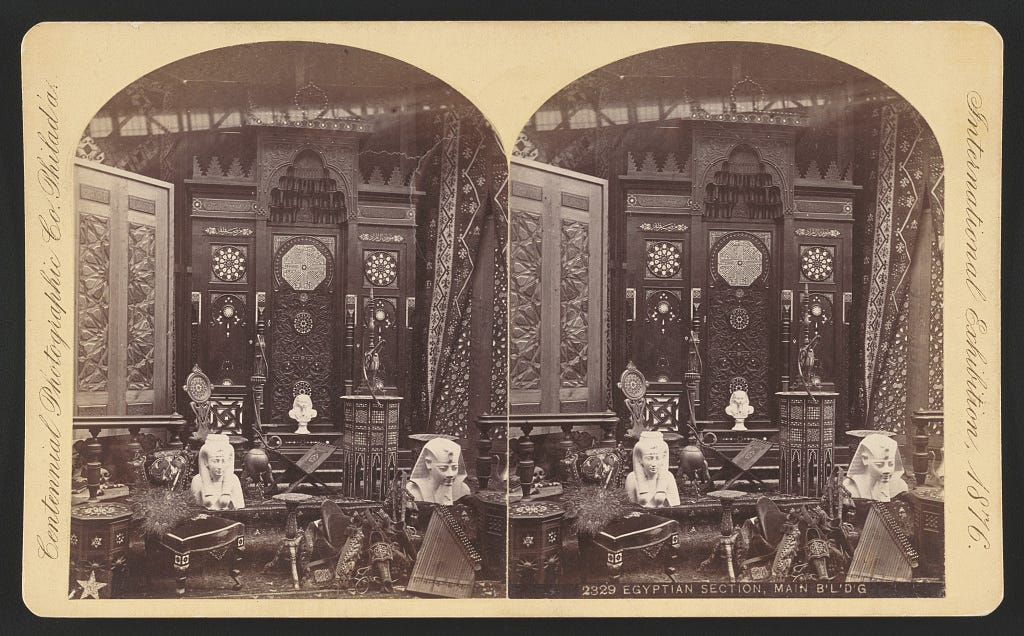
Egypt had inscribed on her enclosure, “The oldest nation in the world sends a morning greeting to the youngest nation.” Among her exhibits were huge dried crocodiles, shells of every size and description, richly embroidered garments and other national manufactures.
New Zealand displayed rich furs and gorgeous leather.
Spain was remarkable for its gold embroideries, laces and jewelry.
Russia brought to the exhibition specimens of very fine green marble, with graining like pictures. We noticed a set of furniture made from elk’s or deer’s horns.
Austria and Hungary offered lovely wares, vases and ornaments of rare beauty, marble, mosaics, Bohemian cut glass and rich jewelry, and some very elegant furniture made from bent wood. We saw a case of 12 buttoned kid gloves which attracted much attention.
The German Empire contributed church ornaments, statuary, paintings, jewelry, fine carpets, velvets of rich texture and color, laid in graceful folds in form of a palace, with bright worsteds so arranged above as to represent a rainbow.
In our next we will give some account of what we saw in other buildings, all we have written thus far having been the exhibits in one building alone.
Orange Free State was an independent Boer republic—a self-governing republic formed by Dutch-speaking inhabitants of the British Cape Colony—which existed in Southern Africa from 1854 until the end of the Second Boer War in 1902.