


Goose Eye No. 4 (2024)
Abolitionizing Bethel
Anti-Slavery Activities and Political Transformation
William F. Chapman
On Friday, February 16, 1866, ten months after the surrender of General Robert E. Lee at Appomattox, the “Eloquent Colored Lady,” Frances Ellen Watkins Harper, addressed an audience at Bethel’s Pattee’s Hall on the subject of “The Lessons of the War, and the Claims of the Freedmen.” In summing up the reaction to her speech, the Bethel correspondent to the Oxford Democrat wrote that “many a man of world wide renown would willingly lose half their present renown if they could speak in public as eloquently as she.”1
Although not a household name today, Harper was indeed one of the most impressive figures of the nineteenth century. An author and poet as well as an abolitionist and suffragist, she was the first Black women to be published in the United States and was a highly sought-after speaker. This was Harper’s second tour in Maine. She had previously contracted with the Maine Daughters of Freedom for a series of speaking arrangements beginning in September of 1854, during which one of her audiences had included Maine Governor Anson P. Morrill.2
That Harper made such a positive impression on her listeners in Bethel that evening is surely a testament to the strength of her abilities and to the moral force of her arguments. But she also spoke before an audience that was primed to be far more receptive to both speaker and message than would have been the case in earlier years. If hearing an “Eloquent Colored Lady” speak was still a novelty in 1866, a few decades prior it would have been nearly unthinkable. The movements that had rocked the country in the nineteenth century—temperance, abolitionism, and women’s suffrage—had broken down barriers to women entering the public sphere. Bethel, Oxford County, Maine, and the whole of the northern United States had experienced a revolution in consciousness.
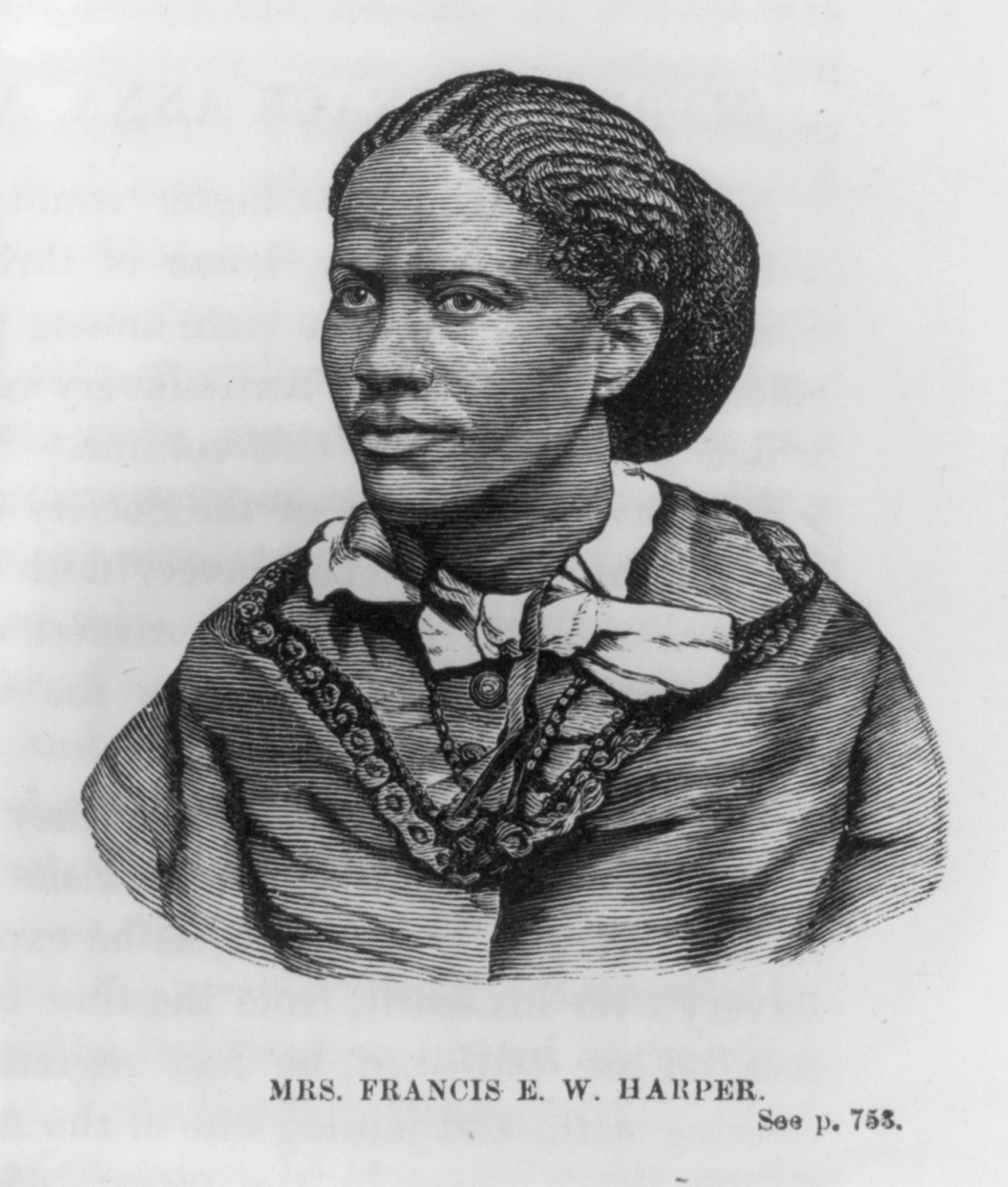
Frances Ellen Watkins Harper is now receiving some of the attention she deserves, thanks to a recent surge of interest in new perspectives on the history of Black Americans and of slavery in the United States, which has produced both new scholarship and new writing for the popular press.3
An important dimension of this historical tidal wave has been to raise public awareness of the fact that the North too participated in slavery, both directly and through economic relations. In Maine, Patricia Q. Wall has documented the extent to which slavery was practiced, while the Atlantic Black Box project has encouraged research on Maine’s ties to the slave trade through the ship-building industry.4
While these are necessary correctives to popular myths, comparatively less attention has been given to the ways in which ordinary Mainers participated in the crusade against slavery. Yet this too is an important part of the story.
For anyone approaching the topic of abolitionism in Maine, the only detailed study of the anti-slavery movement in Maine remains Edward O. Schriver’s Go Free: The Antislavery Impulse in Maine, 1833-1855, published in 1970.5 This work remains a useful reference, but it is now quite dated and suffers from a number of limitations. First of all, the period under study is too short to trace the full arc of anti-slavery ideas. While it is certainly an author’s prerogative to focus their attention on a specific era, in this case it means failing to fully trace either the intellectual origins of the anti-slavery movement or the continuation of anti-slavery politics after the formation of the Republican Party.
Second, Schriver makes the somewhat odd choice to arrange the book according to three separate “impulses” he sees as having motivated anti-slavery activism (“humanitarian,” “political,” and “religious”) when in many cases the participants involved in each were one and the same persons.
Third, Schriver has little to say about grassroots participants in the anti-slavery movement, ignores the role of the free Black people almost entirely, does not mention the Underground Railroad, and does only a bit better with the role of women in the movement. Instead he primarily focuses on the activities and writings of the leaders of the movement in Maine, although he provides little biographical background even on these men.6
In short, it becomes clear that Schriver views the anti-slavery movement in isolation. This limited point of view leads to Go Free’s most serious conceptual error. Throughout the book, and especially in its introduction and conclusion, he suggests that the anti-slavery movement was almost entirely ineffective, “a feeble instrument.” He contrasts the anti-slavery men with more mainstream politicians such as Hannibal Hamlin and William Pitt Fessenden (the son of abolitionist leader Samuel Fessenden), who did not directly affiliate with the movement and “chose … to remain and to work within the existing social structure,” strongly suggesting that the efforts of the latter were ultimately more effective.7
The distinction, however, is too clean and hinges on a faulty assumption. It was not solely the political maneuverings of pragmatically-minded politicians or the relentless advocacy of morally uncompromising activists that led to the eventual abolition of slavery. There were larger social and economic forces which constrained the actions of both the more moderate anti-slavery politicians and the abolitionists. These conditions largely determined the degree to which the former were willing to risk association with the latter and the latter willing to compromise by supporting the former. Most ultimately converged with the impending Civil War and the birth of the Republican Party as an anti-slavery party of the masses.
Consider this: In 1835, the Oxford Democrat surely expressed a common-sense opinion when it editorialized against the “immediate abolitionists” as “misguided men, who pursue a favorite object with a perfect disregard to the consequences.”8 Yet, two and a half decades later Union soldiers would be heading off to battle singing “John Brown’s Body,” a marching song which unabashedly celebrated the legacy of the “martyr” John Brown—a man whose actions had gone far beyond the purported recklessness of the strictly nonviolent approach advocated by the early anti-slavery men.9
What happened in between? Moral agitation and political and economic conditions together led to an ever-widening chasm between North and South—a “house divided against itself,” as Lincoln would famously proclaim. While many Northerners had assumed that slavery wouldi gradually pass away in the South as it had in the North, what actually happened was far different. As Southern plantation owners felt their “way of life” was under attack from slave revolts and abolitionist agitation they further tightened the grip of slavery, passing laws that prohibited teaching Blacks to read, and crafting novel arguments in favor of slavery, which proclaimed that it was a “positive good” for society.
The interests of the North, with its rapidly industrializing economy based on a system of free labor, increasingly diverged from those of the South. But attempts to pass legislation for infrastructural improvements or to protect the nascent manufacturers from foreign competition were consistently foiled by the Southern aristocracy, which held disproportionate power in the legislature, thanks to the “three-fifths” clause and the structure of the Senate. And with fewer opportunities to obtain land in New England, her native sons (especially those born lower in the birth order), increasingly eyed the West, where they sought to preserve “free soil” for white expansionism. All this meant that by the middle of the century, Northerners were growing ever more weary of the strength of the “slave power,” while the South grew increasingly paranoid that slavery was under threat.10
Making sense of these broader shifts is the province of historians who study the political economy of the United States. But local historians have a role to play as well. While examining conditions in individual communities may not be able to elucidate the exact course that led to the Civil War, it may at least provide a way of observing some of the general shifts in public sentiment and point to broader patterns.
What follows is a preliminary sketch of the visible signs of anti-slavery sentiment in Bethel and nearby communities.
In the 1830s, Oxford County, with its tiny Black population and strong Jacksonian culture, is one of the places in Maine where the anti-slavery movement might have seemed the least likely to take hold.
It is no surprise that Matthew Franklin Whittier chose to situate his fictional town of Hornby, home to correspondent “Ethan Spike,” as somewhere in Oxford County very near to “Bethel Hill.”11 Spike was a kind of nineteenth century Archie Bunker, but this was no gentle satire. Written in tortured vernacular language, and replete with racial slurs and violent fantasies—historian William David Barry compared reading Spike to “biting into a fully quilled porcupine sandwich”—Whittier’s Spike letters were nothing less than a full scale assault on the intelligence and character of rural New England Democrats.12
There was a mutual and long-sustained mistrust between enlightened Whigs such as Whittier and the rural Yankee “yeomanry.” In 1835, the Eastern Argus had responded indignantly to a perceived insult to United States Congressman Dr. Moses Mason of Bethel:
The Federal Gazette appears surprised that the Hon. Moses Mason should have been appointed one of the committee to attend the examination at West Point. The Gazette would doubtless prefer a Federal gentleman from the city. One of the “Yeomanry” of the interior, we suppose, would not be intelligent enough for the fastidious Federal critics of the city … It is a little too early for the Federal party in this country to assume such an insulting superiority over the people.13
Yet even here, slavery was debated in the local lyceums, a sizeable minority of voters cast their vote for anti-slavery parties, and local associations were joined. Although my research confirms that radical abolitionists remained a minority, I have found more fragments of evidence than I might reasonably have expected, and believe this research could be fruitfully expanded. In Bethel, and in other towns, the evidence should be thoroughly examined for signs of grassroots opposition to slavery.
Where newspapers and earlier town histories fail us, they should be supplemented or supplanted by fresh examination of the available primary sources. Diaries and letters should be thoroughly read for references to attending anti-slavery meetings or lectures. If none can be found, any opinions expressed on the subject at all are of interest. There has been no event in the history of the United States of greater consequence than the Civil War, and probably no cause of greater moral urgency than the fight to end slavery. Understanding how public opinion transformed on this issue is of vital importance.
Obstacles to Local Anti-Slavery Research
The main reason for the dearth of scholarship examining anti-slavery sentiment in local communities is almost certainly the difficulty of obtaining reliable source material. Many histories of western Maine towns were published in the latter half of the nineteenth century and in many cases they have set the pattern for subsequent efforts. The compilers of these histories had access to sources that are no longer available to us, as well as the ability to correspond with and interview older residents—many just one generation removed from the earliest white settlers in town—but their interests and standards of evidence do not always align with our own.
The nineteenth-century histories of western Maine communities generally contain little information on anti-slavery activity, but we cannot simply take this absence of evidence as necessarily evidence of absence. These histories were often written in the context of a major anniversary and were intended to instill pride in the citizens of the town. Their compilers could be expected to focus on the aspects of their history which united the people of their towns, and not on subjects that had bitterly divided them.
Dr. Nathaniel Tuckerman True, whose “History of Bethel” series appeared in the Bethel Courier newspaper between 1858 and 1861, did not mention anti-slavery at all, while William B. Lapham’s 1891 History of Bethel contains just a few references to the subject.14
Newspapers are another source of information, but as Carol Kammen writes, “Newspapers, especially from the nineteenth century, are not always to be believed.” Most newspapers of the era were explicitly partisan. They were begun by supporters of a political party for the express purpose of advocating the agenda of that party.15
When anti-slavery was first emerging as a live issue, Bethel was served by just one newspaper, the Oxford Democrat, published in Paris, Maine. Before 1850, this paper was generally hostile to abolitionist efforts, and so it could not be counted on to report on them consistently or fairly. Furthermore, local news columns did not appear with any regularity until the 1860s. Prior to that, intermittent news items could most often be found randomly placed throughout the paper, wherever column space allowed.
The Norway Advertiser started in the 1840s, but it is hard to find copies from the early era and a great many issues may in fact be permanently lost. Thankfully, much of the content of the paper is preserved in a series of articles written by Dr. Osgood N. Bradbury entitled Norway in the Forties and first serialized in the Advertiser from 1886 to 1897.16
Norway in the Forties is also somewhat different from other town histories for the candor of its author, who was raised in an abolitionist household. Observing notice of an anti-slavery meeting held in Bethel in 1847, Bradbury comments that:
The young people who read can never know of the intensity of feeling upon the subject of slavery that characterized the Abolition and Anti-Slavery gatherings of those days. That subject like Moses’ rod swallowed up all other subjects. It divided families and churches, split political parties and at the last brought the people of the Republic face to face on the field of battle.17
An example of this divide may be seen in Bethel, where United States Congressman Dr. Moses Mason’s younger brother, Ayers Mason (1800-1890), who owned the Intervale Road farm closest to Bethel village, was “an early anti-slavery man, and an original Republican, though the members of his father’s family in politics, were generally on the opposite side.”18
In 1841, the Congregational Church in Lovell experienced a split among its membership when Moses Heald, a former member of the church who had moved to Georgia, asked for a letter of dismissal that would allow him to transfer his membership to another church. Heald had become a slaveholder in Georgia and a faction of the church, led by Obed Stearns, believed that he should not be permitted to be a member of good standing in any church. Tensions heightened further when Heald returned to Lovell the next fall. Sterns offered two strongly worded resolutions, one stating that:
In view of the course Brother Moses Heald has taken on the subject of holding slaves, this church feel that he has departed widely from Christian principles and the injunction of the Savior, “whatsoever ye would that men should do to you, do ye even so to them, for this is the law and the prophets’, and that he stands suspended from the privileges of the church until Christian satisfaction is given.
The second resolution stated:
As a church of Christ we feel called upon to bear our public testimony against American Slavery as being a great moral evil and a sin against God of the blackest dye, especially when practiced by those who profess to be followers of the meek and lowly Jesus. Therefore, be it resolved that we cannot, after comparing this cove and odious system with the mild spirit of the gospel, invite a slave-holding professor to sit with us at the communion table.
The debate was the topic of no less than six church meetings, with the resolutions first passed and then rescinded and then finally passed again as originally written.19
Early Anti-Slavery Efforts
Slavery was practiced in Maine from colonial times. It was brought to an end in the 1780s, when, after a series of court cases in which enslaved people successfully sued for their freedom, the Massachusetts Supreme Court issued a ruling in 1783, effectively banning slavery in the state.20
Slavery had again been pushed into public debate with the “Missouri Compromise” of 1820, when, after Maine overwhelmingly voted for independence from Massachusetts, the United States Senate linked its admission to the Union as a free state with the admittance of Missouri as a slave state. When the bill went to the House, five of the seven Massachusetts Congressmen representing the District of Maine voted against the compromise, but it passed anyway, by a narrow margin that required both of the two Maine votes in favor.21
From 1816, the American Colonization Society had promoted the idea of gradually ending slavery, compensating former slaveholders for their lost “property,” and encouraging (or forcing) free Black people to emigrate to Africa. In 1821, the Society even purchased land in Liberia and established a colony for this purpose, but over the ensuing decades not more than few thousand people actually emigrated. Unsurprisingly, this “solution” was roundly rejected by nearly all free Black people in the United States.
Abolitionist efforts began in direct opposition to colonization. William Lloyd Garrison started his newspaper The Liberator in 1831, and launched a full scale attack on the Colonization Society with his Thoughts on African Colonization in 1832. In the fall of 1832, Garrison spoke at several places in Maine and debated an agent of the Colonization Society in Augusta.22
The first Anti-Slavery societies in Maine started in 1833. The most notable was born at a meeting at the house of Ebenezer Dole of Hallowell. Following the formation of the American Anti-Slavery Society in Philadelphia the same year, state and local anti-slavery societies were encouraged to form. The Maine Anti-Slavery meeting held its first convention in October of 1834.23
In 1835, the Oxford Democrat noted with scorn that anti-slavery meetings had been held in “most of the large towns” in Maine. Efforts were apparently underway in smaller communities as well. In the same issue, the Democrat claimed that, “The Abolitionists have a stronger team in Otisfield than the Whigs.” Of course, this may have been intended more as a taunt to the Whigs than a truly objective assessment of the strength of the abolitionist movement.24
The first Oxford County towns in which local anti-slavery societies were organized appear to have been Hebron and Weld. These societies formed before mid-1835. The Oxford County Anti-Slavery society may have formed in the next year, and a Dixfield society had formed by 1838.25
During the 1830s there was no attempt made to enter politics, and most of the early societies were guided by the principles of Garrison, who entirely opposed such efforts.26
Instead the principal tool of the early anti-slavery crusaders was moral suasion through public lectures, meetings, and the publishing of tracts and periodicals. The “agency system” sent lectures around New England. In Maine, Rev. David Thurston of Winthrop took up this post and visited a number of places in Oxford County in 1837, including Peru, Dixfield, Rumford, Norway, and South Paris. According to Thurston, “A constitution of an Anti-Slavery Society in Norway and Paris had upwards of sixty names attached to it before I left.”27
Although Thurston did not visit Bethel on this leg of the tour, another anti-slavery lecture was apparently arranged in Bethel that year. The lecturer is not known, but his appearance was said to have “excited great opposition” and “not only sneers and threats were thrown out, but signs of physical violence.” Nonetheless, the speaker carried on, according to an anonymous writer from Bethel who recalled the incident a year later.28
Eighteen thirty-seven turned out to be a year of great excitement for Maine’s small abolitionist movement, as it was in this year that Elijah Lovejoy was murdered by an anti-abolitionist mob in Alton, Illinois. Lovejoy, one of the nation’s first martyrs to freedom of the press, was born and raised in Albion, Maine, and his killing provoked much excitement in his native state.29
Thomas Treadwell Stone, of East Machias, who was formerly the minister of the Congregational Church in Andover, Maine, was one who was now willing to formally “connect” himself with the Anti-Slavery Society after having previously been reluctant to do so. It was not, he explained, simply the outrage of the killing itself, but attempts to divert public attention from slavery and to blame Lovejoy himself for having incited the riot that “broke the last link which connected me with the opposers of abolitionism.”30
At the third annual meeting of the Maine Anti-Slavery Society, in Augusta, numerous resolutions were passed, including one condemning the murder of Lovejoy. The idea of starting an anti-slavery newspaper in Maine was also discussed. This was done, and the first issue of the Advocate of Freedom appeared on March 8, 1838.31
Later that year, Thurston came to Bethel and Gilead. He was joined by Charles L. Remond, a Black abolitionist and orator who was an agent of the New England Anti-Slavery Society. This in itself created something of a sensation, for, as Thurston wrote, “many of the people in this region, thirty or thirty-five years old, ha[d] never before seen a colored person.” Nonetheless, in contrast to the lecture which had taken place a year prior, this one was reported to have been met with little opposition.32
Anti-Slavery Men Enter Politics
In 1840, the American Anti-Slavery Society split. The two primary issues that caused the split were whether women should be able to participate as full members, and the advisability of political action. One outcome of the split was that a national Liberty Party formed and fielded James G. Birney of Kentucky as its candidate for president. The electoral effort got off to a slow start; nationally, Birney received just 0.3% of the recorded popular vote. There’s evidence however, that at least a handful more votes went untallied. According to Osgood Bradbury, his father Jacob Bradbury cast one of the first two Abolition ballots in Norway, and, the younger Bradbury recalls, “If my recollection serves me those two votes were considered so very scattering they were not counted at all.”33 A few similar reports may be found in other nearby towns. In Bridgton, Lothrop Lincoln Lewis is reported to have cast one of just three votes in town for Birney in 1840.34 It should come as no surprise that no votes for the Liberty Party were recorded in Bethel that year either.
By the next year, however, the Liberty Party men were well enough organized to field a candidate for Governor, and in August of 1841, a call appeared in the Norway Advertiser for “all persons friendly to a Liberty Association in Norway to meet at the Town House on Saturday next at 3 p.m., to form such Association.”35
From 1841 to 1848, in the election for Governor of Maine, the Liberty Party often outpolled the Whig Party in Bethel, though the Democratic Party continued to reign supreme.36
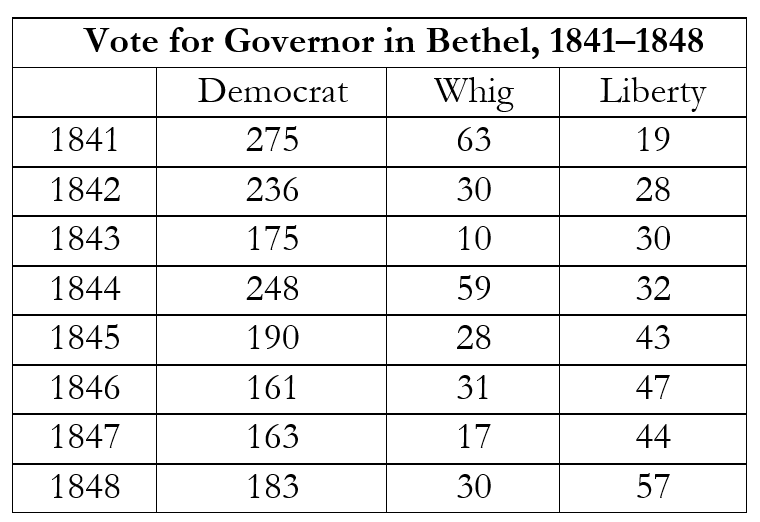
This is presumably what William B. Lapham refers to when he writes that the “small Whig party embraced some of the most intelligent men in town, but they became divided upon the slavery issue and for several years there were three parties in town.”37
The Liberty Party vote is, at best, a blunt instrument for gauging of anti-slavery sentiment. In the first place, some men who may have otherwise sympathized with the cause may have simply been skeptical of single-issue political parties. But the more serious issue is, of course, that it was only men who were able to vote at this time. If it is a difficult enough task to look for general indicators of anti-slavery sentiment at this time, it is still more difficult to assess the role played by local women. Yet we know from evidence around the country that women made up an important part of what William Lloyd Garrison called the “great army of silent workers” that made the abolitionist movement possible.38
While it is not clear whether formal membership in the Oxford County Anti-Slavery Society was open to both men and women, Julie Roy Jeffrey draws our attention to the fact that “liberty men and women” alike were encouraged to come to the Society’s annual meeting at South Paris in 1847, where both the attendees and their horses would have their needs attended to by the anti-slavery men and women of South Paris.39
The Oxford County Anti-Slavery society met in Greenwood in 1846 and the Liberty Party convention met at the Congregational meeting house in Bethel the next year.40 These conventions were multi-day affairs. They show, despite a lack of extant record books, that the anti-slavery and Liberty Party supporters in these towns were well organized enough to arrange the accommodations necessary to host a countywide gathering.
The Bethel Convention was opened with a prayer led by Rev. Rand of the Congregational Church. Joseph Stephens of Greenwood was chosen President of the convention, while Jonathan A. Russell and Leonard Grover, both of Bethel, were chosen Secretary and Associate Secretary. Among the resolutions passed was one specifically supporting the participation of women:
Resolved, That we fully appreciate the influence of women in this as in every benevolent reform, and welcome them, and solicit their renewed co-operation and activity in the field of Anti-slavery labor.
George Whitefield Chapman of Bethel was chosen a member of the committee to obtain subscriptions for the Liberty Association, as were Joseph Small, Rumford; Joseph Stephens, Greenwood; Reuben Foster, Hanover; William Frost, North Norway; James Eames, Newry; and Timothy Hutchinson, Albany.41
The Oxford County Liberty Party convention was held in Otisfield in 1848.42 This was the last year the party fielded a candidate for Governor, but the Free Soil party soon formed to take its place.
Political Transformation
By the 1840s and 1850s, a younger generation was coming of age in an environment where anti-slavery ideas could be more vigorously debated. Alonzo J. Grover (1828-1891) was noted to be a “decided abolitionist” who from his student days had held, “radical views upon political questions of the day.” Grover’s interest in such topics was nurtured by the debating society at Gould Academy, where he “delighted in the discussion of questions before the lyceum, in which his peculiar sentiments could be indulged in.”43
Timothy Appleton Chapman (1824-1892), the son of George Whitefield Chapman, was “strongly in sympathy with the Abolitionist movement, and a supporter of Wendell Phillips, Charles Sumner, John G. Whittier, and William Lloyd Garrison, long before their doctrines became popular.”44
The organization of the Free Soil Party brought the movement closer to the mainstream. Less radical than the Liberty Party, it nonetheless had the support of most of the Liberty men. The party focused narrowly on the single issue of opposition to the extension of slavery into the new Western territories, something a great number of Northerners could get behind.
As recently as 1848 the Oxford Democrat’s position on even this form of anti-slavery politics remained quite hostile:
The citizens of Norway opposed to the extension of slavery held a meeting last Saturday. The call was addressed to the advocates of Free Soil, Free Speech, Free men, and Northern Rights. All democrats would approve this so far as it goes; but true democrats go still farther—they advocate the rights of the whole Union. This advocating of a particular section alone is not democratic.45
The political winds were shifting, however, and the Oxford Democrat would soon play a key role.
By 1849, the Maine Democratic Party had become deeply divided. One faction of the party, which came to be known as “Woolheads,” strongly opposed the extension of slavery and sought to lure back Democrats who had joined the Free Soil Party. This faction succeeded in securing the nomination of John Hubbard for Governor. Their opponents, the “Wildcats,” opposed Hubbard and declared they “would never consent to make opposition to slavery the test of political orthodoxy.”46
The party was nearly ready to split over the slavery issue, but with the Compromise of 1850, the importance of slavery temporarily receded, and after the passage of the Maine Law—the first state law in the nation banning the sale of alcoholic beverages—in June of 1851, the temperance issue took center stage. Austin Willey said that, “All Free Soil Men were Maine law men, and the interest in the vigorous execution of that law diverted some labor from the cause of liberty.”47
The long-anticipated split finally took place in 1852, when the Wildcats, unhappy with Hubbard’s reelection, nominated their own candidate, Anson G. Chandler, for Governor. Although Hubbard’s signing of the Maine Law was the breaking point, the slavery issue was never far from mind.48 Hubbard received a large plurality of the votes that year, he failed to gain the majority needed. The decision went to the legislature, where, by the Maine Constitution, it was up to the Legislature to select two candidates and the Senate to choose between them. In the end, Hubbard and Whig candidate William G. Crosby were offered up and two Wildcat senators from Oxford County swung the ballot to Crosby.49
The next year, it was the Wildcats who succeeded in gaining control of the state Democratic convention. They nominated Albert G. Pillsbury, who upset the Woolhead faction with his refusal to clarify his position on the Maine Law. This time it was some of the most fervent Woolheads who moved to bolt.50 They received the strong support and, indeed, the active involvement, of the Oxford Democrat.
In late 1849, a fire at the Oxford Democrat office had preceded a series of changes in ownership. When longtime publisher George W. Millett obtained new equipment and restarted the paper in February of 1852, he brought on George L. Mellen as co-publisher, and then soon sold out altogether. Mellen ran the paper for a few years with co-proprietors and then as sole proprietor. In May of 1853, he installed as editor Dr. Thomas H. Brown, who wasted no time in staking out strong positions against slavery extension and in support of temperance.51
Then, on July 15, 1853, Mellen announced the sale of the Democrat to Noah Prince, who immediately used his new organ to issue a call for a State Convention in Portland for those Democrats who were opposed to selection of Pillsbury to nominate an alternative candidate for Governor. This was followed by a call issued August 5 for an Oxford County convention of those in favor of the Convention in Portland, which had chosen Anson P. Morrill. Among the signers of this call were Robert A. Chapman of Bethel and John J. Perry of Oxford, who was also associated with the Oxford Democrat and would later become its editor.52
Morrill placed third in the election statewide, but he polled second in Bethel, garnering 125 votes to Pillsbury’s 187, while Free Soil candidate Ezekiel Holmes managed 50.53 There again being no majority, the election went to the legislature, where Crosby again emerged victorious with the support of half the Whigs and nearly all of the Wildcats.54
The next year, however, Morrill, backed by a strong coalition of Whigs, Free Soilers, and Morrill Democrats, nearly won an outright majority and was elected Governor by the Legislature. His total in Bethel was 222 to Albion K. Parris’ 143.55
It was this coalition that went on to re-nominate Morrill and to form the Republican Party in Maine in 1855. And so it is with perhaps only slight exaggeration that historian William Berry Lapham boldly declares, “The Republican party of Maine, therefore, had its origin in Oxford County, and the Oxford Democrat was its first out-spoken and recognized organ.”56
Furthermore, the stakes were now clear to all and there was no mistaking the most important issues. In his journal of July 29, 1855, Ezra F. Beal of Norway, a rare diarist who wrote about more than just the daily weather patterns, summarized the upcoming election in the following terms:
The present is a very exciting political period. The excitement is greater than ever before in Maine. The contest is now between Rum and Slavery power and the Temperance and Freedom power. Much bitterness prevails.57
Morrill did not win the election this time. He garnered the most votes, but again, not quite a majority, and the Democratic-controlled legislature chose Samuel Wells. Wells served for one-year (which the Oxford Democrat labeled his “crow-bar” administration), before being roundly defeated the next year by Hannibal Hamlin who gathered a 19,000 vote majority.58
Hamlin, Oxford County’s favorite son, received 310 votes in Bethel in 1856, to Samuel Wells’ 195, inaugurating many decades of Republican domination.59 As Lapham put it in 1891:
When the Republican Party was formed, this town gave it a hearty support, and since that time, a period of thirty-six years, it has uniformly given adherence to that party. None of the leading old time Democrats joined the new party, but lived and died in their early political faith, but the young men have been largely Republican.60
The margin grew still larger in the 1860 election. With Hamlin as Lincoln’s running mate, the presidential electors for “The Railsplitter” garnered 260 votes in Bethel to 101 for Stephen Douglas.61
We can only imagine now the excitement that the pro-Lincoln forces must have felt on the eve of the most consequential election in their nation’s history. Perhaps as many as 100,000 young men in the North took part in the “Wide Awake” movement, joining clubs that were part political association and part paramilitary organization.62 These clubs consisted of the youngest and most enthusiastic supporters of the new Republican Party. When the War of Rebellion began many of them would transition into Union Army units.
Wide Awake Clubs were formed in nearby towns such as South Paris and Bridgton, and there is no doubt that Bethel men participated.63 A “Mass Ratification Meeting” at Paris Hill on July 10, 1860, was reported to have been attended by 6,000 people. “From the North, they came from Andover, … Rumford, Mason, Gilead, Bethel, Hanover, Woodstock, Peru, Mexico, Dixfield, Greenwood, and Albany,” to hear speeches and to watch the mustering of the Portland Wide Awake Club, which had arrived on a special train and formed behind a line of 150 wagons to march from Norway.64
Two months later, on September 1, 1860, a “Grand Republican Rally” held in Fryeburg attracted some 4,000 people, if the Democrat is to be believed. There they were addressed by Israel Washburn, Jr., who was soon to be elected Governor.
The speakers’ stand, “tastefully decorated with evergreens and flowers, by the ladies of Fryeburg,” was adorned with three banners bearing mottos. At the left: “Liberty and Union, Now and Forever.” At the right, a quote attributed to President Monroe: “Slavery has preyed upon the vitals of the Union.” And in the center:
THE YOUNG MEN ARE
“WIDE AWAKE!”65
The young men were indeed “Wide Awake,” and even though some of the men, young and old, may not have noticed yet, the young women were too.
Oxford Democrat, February 23, 1866. The subject of her lecture is not specified in this brief article, but I surmise it is the same as that which was to be given in Gardiner the next Saturday. Gardiner Home Journal, February 22, 1866.
For more on Harper’s first tour of Maine, see Marcia C. Robinson, “Frances Ellen Watkins Harper,” in Maine’s Visible Black History: The First Chronicle of Its People, ed. H. H. Price and Gerald E. Talbot (Gardiner, ME: Tilbury House, 2006), 265–66.
Ian Zack, “Overlooked No More: Frances Ellen Watkins Harper, Poet and Suffragist,” New York Times, February 7, 2023, https://www.nytimes.com/2023/02/07/obituaries/frances-ellen-watkins-harper-overlooked.html.
Patricia Q. Wall, Lives of Consequence: Blacks in Early Kittery & Berwick in the Massachusetts Province of Maine (Portsmouth, NH: Portsmouth Marine Society, 2017); Atlantic Black Box, “About Atlantic Black Box,” https://atlanticblackbox.com/about/.
Edward O. Schriver, Go Free: The Antislavery Impulse in Maine, 1833-1855 (Orono: University of Maine Press, 1970). Austin Willey’s The History of the Antislavery Cause in State and Nation (Portland, Maine: Brown Thurston, 1886), which Schriver calls a “lively, but slanted, contemporary account,” is, in fact, still indispensable. Schriver, Go Free, 115.
See Price and Talbot, Maine’s Visible Black History, and Julie Roy Jeffrey, The Great Silent Army of Abolitionism: Ordinary Women in the Antislavery Movement (Chapel Hill: University of North Carolina Press, 1998), for excellent treatments of some of these issues.
Schriver, Go Free, 110, iii.
Oxford Democrat, September 1, 1835.
Set to the tune of the older folk hymn, “Say, Brothers will you Meet Us,” the song originated among soldier in the earliest months of the Civil War. Julia Ward Howe wrote the better known lyrics to the “Battle Hymn of the Republic,” based upon the same tune in November of 1861.
See Matt Karp, “The Mass Politics of Antislavery,” Catalyst 3, no. 2 (2019), 131–78, for an excellent overview of how Northern politicians successfully linked the argument against slavery to the material concerns of their voters. Karp is careful to note that legislation supportive of homesteading, “depended on an assumption that the North American West rightly belonged to Euro-American settlers, not its indigenous inhabitants.”
Matthew Franklin Whittier, Diggio, Haybis Korpus & E Plewrisy Unicorn!: The Thinkin’ and Doin’ of Ethan Spike, of Hornby, Oxford County, Maine, ed. Larry Glatz (Bethel, ME: Museums of the Bethel Historical Society, 2021), 17–19.
William David Barry, “A forgotten 19th-century Maine comic writer gets his day in the sun,” Portland Press Herald, June 5, 2022.
Eastern Argus (Portland, ME), May 27, 1835. Emphasis in original. Although the Argus was published in Portland, it was a Democratic paper, which aligned strongly with the rural “yeomanry” as well as that city’s working class whites, and was read by farmers in rural Maine.
Nathaniel Tuckerman True, The History of Bethel, Maine, ed. Randall H. Bennett (Bowie, MD: Heritage Books, 1994); William B. Lapham, History of Bethel, Formerly Sudbury Canada, Oxford County, Maine, 1768-1890 (Augusta, ME: Press of the Maine Farmer, 1891). Three of these are references to individuals while one describes a split in the Whig Party. Each of these will be taken up below.
Carol Kammen, On Doing Local History: Reflections on What Local Historians Do, Why, and What It Means (Nashville: American Association for State and Local History, 1986), 61.
These articles were later collected and published in book form. Osgood N. Bradbury, Norway in the Forties, ed. Don L. McAllister (Norway: Twin Town Graphics, 1986), ii.
Bradbury, Norway in the Forties, 89.
Lapham, History of Bethel, 143. It was not only his father’s side of the family, for Mason’s own son-in-law Clark S. Edwards remained a Democrat throughout his life, and was the party’s unsuccessful candidate for Governor of Maine in 1886.
Pauline W. Moore, Blueberries and Pusley Weed: The Story of Lovell, Maine (Portland, ME: House of Falmouth, 1980), 128–29.
For more on the “first abolition” in Maine, see Andy O’Brien and Will Chapman, “Radical Mainers: The End of Slavery in Maine,” Mainer, June 2020.
Miller, Kevin, “Vote on Maine statehood was far from assured 2 centuries ago,” Portland Press Herald, July 29, 2019, https://www.pressherald.com/2019/07/29/vote-on-maine-statehood-was-far-from-assured-two-centuries-ago/.
Schriver, Go Free, 4–5.
Schriver, Go Free, 23.
Oxford Democrat, September 1, 1835.
Listings of local societies may be found in the annual reports of the American Anti-Slavery Society, which are careful to note that they are probably incomplete. Hebron and Weld are listed beginning in the Second Annual Report, which does not give dates of formation. Beginning in the Third Annual Report, which lists Hebron and Weld again, as well as an Oxford County society, there is a column for the date a society formed, but it is supplied only for Hebron (May 1835). Second Annual Report of the American Anti-Slavery Society (New York, 1835), 83–87; Third Annual Report … (New York, 1836), 89; Fifth Annual Report … (New York, 1838), 129.
Garrison also condemned the United States Constitution as a pro-slavery document, a position that most abolitionists came to reject. When the Oxford County Anti-Slavery Convention met at the courthouse in South Paris on August 16, 1843, they passed a resolution stating: “That the framers of the Constitution contemplated the Abolition of Slavery in the States.” Oxford Democrat, August 29, 1843.
John L. Myers, “The Antislavery Agency System in Maine, 1836–1838,” Maine History 23, no. 2 (1983): 57–84; Advocate of Freedom, April 12, 1838.
Advocate of Freedom, August 16, 1838. The letter is simply signed, “R.”
The newest, and best, biography of Lovejoy is Ken Ellingwood’s First to Fall: Elijah Lovejoy and the Fight for a Free Press in the Age of Slavery (New York: Pegasus Books, 2021).
Advocate of Freedom, April 26, 1838.
Advocate of Freedom, March 8, 1838. This newspaper was published in Brunswick, Maine, and edited by William Smyth, a professor at Bowdoin College. Willey, History of the Antislavery Cause, 82.
Advocate of Freedom, August 16, 1838.
Bradbury, Norway in the Forties, 441. Bradbury does not specify what year this was, but that the ballot referred to was cast in the 1840 election for Birney seems the most likely.
Bridgton, Maine, 1768-1968 (Bridgton, ME: Bridgton Historical Society, 1968), 331.
Norway Advertiser, August 9, 1841, quoted in Osgood N. Bradbury, Norway in the Forties, ed. Don L. McAllister (Norway: Twin Town Graphics, 1986), 11.
Under the 1820 Constitution, the term of the Maine Governor was originally just one year. This was amended to two years in 1879 and to four years in 1957.
William B. Lapham, History of Bethel, Formerly Sudbury Canada, Oxford County, Maine, 1768–1890 (Augusta, ME: Press of the Maine Farmer, 1891), 159.
Quoted in Jeffrey, The Great Silent Army of Abolitionism, 1.
Liberty Standard (Hallowell, ME), February 11, 1847, quoted in Jeffrey, The Great Silent Army of Abolitionism, 164.
Norway Advertiser, February 13, 1846, quoted in Bradbury, Norway in the Forties, 26; Norway Advertiser, January 22, 1847, quoted in Bradbury, Norway in the Forties, 88–89.
Liberty Standard, February 25, 1847. I thank Jonathan Harris, Library Assistant at Fogler Library, University of Maine, for locating this article for me.
Portland Advertiser, March 28, 1848.
Lapham, History of Bethel, 262.
Lapham, History of Bethel, 361–62.
Oxford Democrat, September 5, 1848.
Resolution passed by the Wildcat dominated Cumberland County convention, quoted in Richard R. Wescott, New Men, New Issues: The Formation of the Republican Party in Maine (Portland: Maine Historical Society, 1986), 78.
Willey, History of the Antislavery Cause, 380, quoted in Wescott, New Men, New Issues, 91.
Westcott, New Men, New Issues, 91–92.
Westcott, New Men, New Issues, 98, 104–5.
Westcott, New Men, New Issues, 106–8.
William B. Lapham, Semi-centennial of the Oxford Democrat: Sketch of the Paper from the First, with Notices of its Editors, Publishers, &c. (Paris, ME: Oxford Democrat, 1884), 7–8.
Lapham, Semi-centennial of the Oxford Democrat, 8.
Westcott, New Men, New Issues, 109–110; Bethel, ME, Town meeting records, 1796–1870. Incumbent Whig Governor William G. Crosby polled just 37 in Bethel that year.
Westcott, New Men, New Issues, 111.
Westcott, New Men, New Issues, 121. Lapham, Semi-centennial of the Oxford Democrat, 9; Bethel, ME, Town meeting records, 1796–1870. Morrill also received the backing of the anti-immigration “Know Nothing” Party, an association that may surprise readers today, but in this era anti-immigrant sentiment, especially towards Catholic immigrants, often accompanied anti-slavery and pro-temperance politics. In 1855, the Daughters of Freedom, a female anti-slavery organization, presented Governor Wells with a ceremonial cake, inscribed with mottoes such as “We detest and resist oppression,” but also, “We oppose the claims of Popery.” Bangor Daily Whig and Courier, March 3, 1855. These attitudes deserve further examination but are beyond the scope of this article.
Lapham, Semi-centennial of the Oxford Democrat, 10.
Ezra F. Beal, Journal of Ezra F. Beal: Diary Kept by a Distinguished Son of Norway, ed. Don C. Seitz (1926), 28. Beal did write about the weather too.
Westcott, New Men, New Issues, 138, 154; Oxford Democrat, September 4, 1857. Morrill’s total in Bethel in 1855 was 262 to Wells’ 226, a smaller majority than the previous year.
Bethel, ME, Town meeting records, 1796–1870.
Lapham, History of Bethel, 159.
Bethel, ME, Town meeting records, 1796–1870. “The Railsplitter” was the nickname used during Lincoln’s 1860 campaign. Lincoln’s working-class image was another asset in winning over former Democratic strongholds in the North.
Karp, “The Mass Politics of Antislavery,”153–54.
Oxford Democrat, August 3, September 7, 1860.
Oxford Democrat, July 13, 1860. “Ratification” meaning to endorse the platform of the Republican Party.
Oxford Democrat, September 7, 1860.
So glad I found this, and I really appreciate your documentation. I am the principal researcher of Weld's once enslaved Pomp Russell, and his relationship to his large, extended network of the white side of his family-- including the Abbots. This crew started two of the earliest anti-slavery societies in Maine ...and the country. I am editing a presentation for a history conference in Boston (what I should be doing, rather than responding to your stellar article). The focus is on Maine's female anti-slavery societies and their Gathering of 10,000 in E. Livermore on July 4th, 1854. Might be fun to talk sometime. Best, Judy Granger